

Qualtrics is one of the most recognised Experience Management (XM) platforms on the market and for many organisations it remains a strong choice.
But in 2026, more European teams are re-evaluating whether an American broad global XM suite is the best fit, not only because of workflow complexity, but also because of data governance expectations inside the EU.
That’s why we’re looking into the top 6 European alternatives to Qualtrics in this blog
With GDPR scrutiny rising and concerns about extraterritorial access risks such as the U.S. CLOUD Act, many organisations are actively prioritising European providers that align more naturally with EU laws and procurement requirements.
At the same time, digital, user experience (UX), product and customer experience (CX) teams are under pressure to move fast: identify friction in journeys, collect feedback at the right moment and turn insights into action without heavy implementation cycles.
Therefore, more organisations are actively comparing European alternatives to American vendors, like Qualtrics.
TL;DR – Article summary
If you are comparing Qualtrics alternatives in Europe, the best choice often comes down to European compliance and operational fit, not feature count. Many organisations are prioritising providers aligned with GDPR, accessibility expectations such as WCAG and the European Accessibility Act and other European laws, while still needing a platform that scales across teams and delivers fast, in-context insight across digital journeys. In this blog, we break down 6 European alternatives that align with these standards.
Why more European organisations are looking beyond Qualtrics
Qualtrics is a powerful platform, but for many teams the question is not feature access. It is whether the platform matches how feedback needs to work in practice inside European organisations, including expectations around data governance and compliance.
That is why more European teams are exploring providers that are designed with European needs in mind, combining actionable digital feedback workflows with clear alignment to regional laws, procurement expectations and support requirements.
Common priorities driving the shift in 2026
Across digital-first and mid-market organisations, the same priorities appear again and again:
- Faster time-to-value: Teams want to launch quickly and start learning fast, not spend months configuring workflows before seeing results.
- Feedback collection within digital journeys: Feedback needs to happen in the journey across website, app and email touchpoints, not only through generic surveys after the fact.
- Better targeting and timing: Feedback becomes significantly more useful when it is triggered at the right moment, such as exit intent, drop-off, post-transaction or feature interaction.
- Actionability for UX, CRO and product teams: Teams need insight they can act on, not just dashboards full of scores.
- GDPR-aligned infrastructure and support: For many European organisations, compliance and governance fit must be clear from the start, not added later.
For many teams, the decision is less about platform size and more about which tool helps them improve experiences faster.
How we selected these alternatives
This list is designed for teams comparing Qualtrics from a European, digital-first perspective. We selected these platforms based on a mix of relevance in Qualtrics comparison conversations, fit for digital feedback and customer experience workflows, use across UX, conversion rate optimisation (CRO), product or CX teams, practical adoption potential for European organisations and clear differences in positioning. Compliance with European requirements, including GDPR and accessibility expectations, also plays a role in why these tools are commonly shortlisted.
Not all platforms below are direct replacements for Qualtrics and that is intentional. Some are broader alternatives, while others are better seen as complementary tools depending on your strategy.
1) Mopinion (part of Netigate)
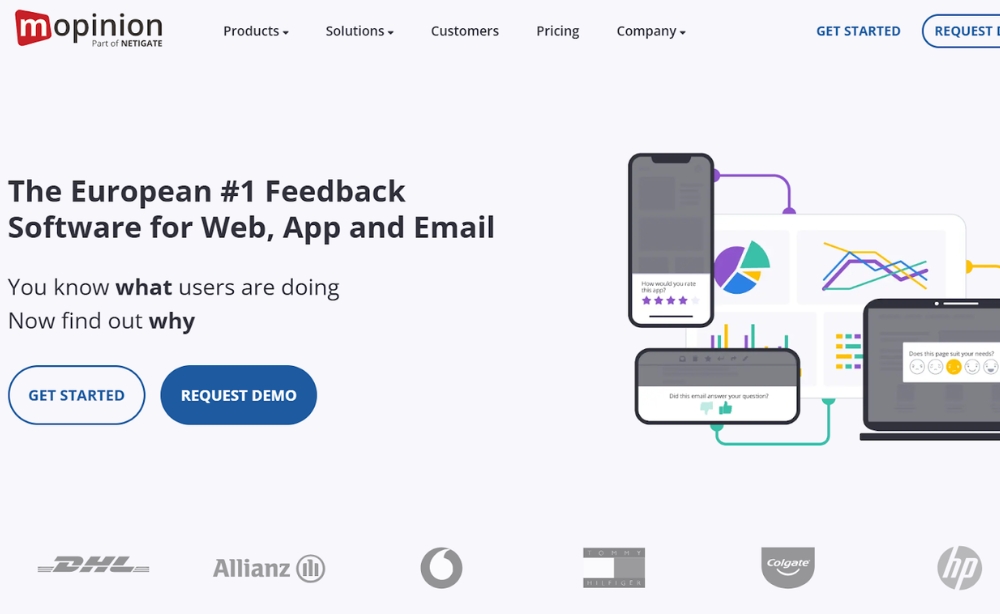
Mopinion (part of Netigate) is built for digital feedback intelligence, helping organisations collect feedback in context across websites, apps and email touchpoints. It supports teams that need to improve digital journeys while meeting European requirements such as GDPR-aligned data handling and accessible feedback collection that aligns with WCAG standards. With highly customisable feedback forms that can blend seamlessly into your brand, teams can capture feedback during real customer interactions, so insights stay tied to what users are experiencing in the moment.
Because Mopinion is part of Netigate, organisations can also expand into a broader experience management setup over time, combining deep digital journey feedback intelligence with wider customer experience (CX) and employee experience (EX) capabilities as needs grow. This makes Mopinion a strong European option for enterprise organisations building a scalable digital feedback strategy, especially when the goal is to move quickly without compromising on governance, accessibility or cross-team rollout.
Best for
Organisations that want to improve digital experiences faster through in-context feedback and actionable insight.
Where Mopinion is useful
Mopinion is especially useful for CX, UX, CRO, eCommerce and product teams that need feedback they can act on quickly. Common use cases include:
- real-time website and in-app feedback
- feedback collection at key journey moments (for example, checkout drop-off, exit intent or page friction)
- highly customisable feedback forms
- advanced targeting and trigger logic
- routing feedback to the right internal teams with several integration options
- AI-powered summarisation and categorisation of open feedback comments
- automatic and custom dashboards for digital journey and performance analysis
- GDPR and WCAG compliant
Website: www.mopinion.com
2) Hotjar
Hotjar is widely used for behavioural analytics, especially heatmaps and session recordings. It helps teams understand how users interact with pages, where they click, how far they scroll and where they drop off. That makes it useful for usability diagnostics and conversion research and it also offers website feedback widgets for collecting input directly on your site.
In practice, Hotjar is strongest for website-focused workflows. If your strategy includes collecting feedback beyond the website, such as in-app or email feedback, or if you need deeper form customisation and advanced targeting, teams often complement Hotjar with a more dedicated digital feedback platform.
Best for
Teams that need visual behavioural insight to support UX research and conversion optimisation.
Where Hotjar is useful
Hotjar is commonly used by UX and CRO teams for heatmaps, session recordings, click and scroll behaviour analysis and on-page feedback widgets, especially when the main goal is to observe behaviour and identify friction visually.
Website: www.hotjar.com
3) Survicate
Survicate is a survey-focused platform used by many SaaS and product-led organisations. It supports feedback collection across multiple channels, including web, in-app, email and link-based surveys. It is often chosen by teams that want a simpler setup and faster rollout than a large enterprise XM platform, especially for standard CX metrics.
Survicate can be a practical option for launching structured programmes quickly, but organisations that prioritise deep digital journey diagnostics, advanced behavioural-triggered feedback, or highly granular page-level targeting may find they need a more specialised digital feedback approach alongside it.
Best for
Teams that want to launch structured feedback programmes quickly across multiple channels.
Where Survicate is useful
Survicate is commonly used for structured feedback programmes such as NPS, CSAT, CES, onboarding surveys and churn and lifecycle feedback.
Website: www.survicate.com
4) Screeb
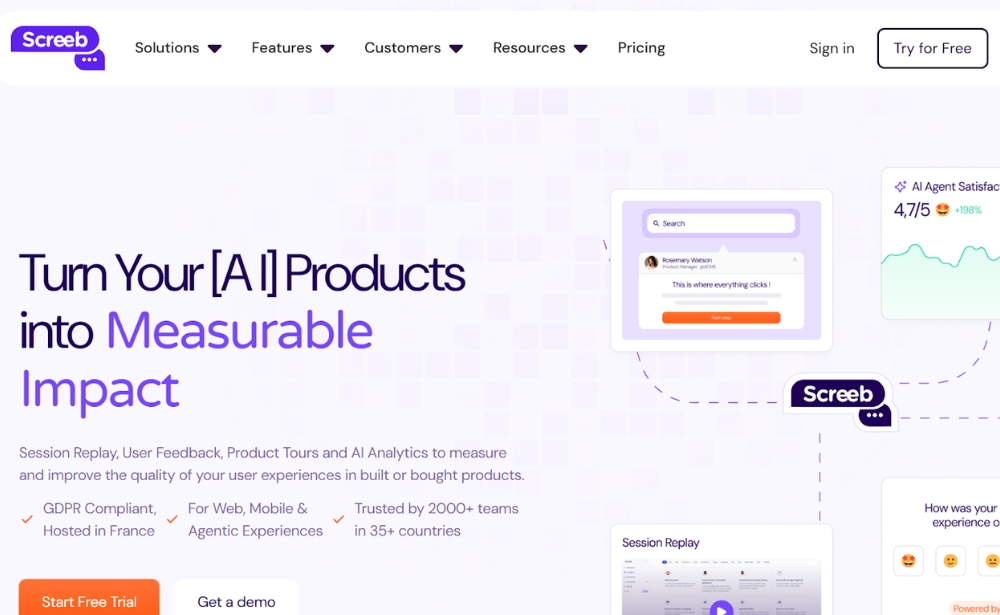
Screeb is positioned around in-product feedback and product analytics. It is mainly designed for software and product teams that want to collect user feedback directly inside their product and connect it to feature usage. Its positioning is clearly product-focused rather than broad CX or XM.
For product-led teams, this setup can be very useful in discovery and roadmap workflows. For organisations looking for broader coverage across website, app and email touchpoints, or for wider CX workflows across multiple teams, Screeb is typically evaluated as part of a product feedback stack rather than as a full Qualtrics alternative.
Best for
Product-led teams that want in-app feedback tied to feature usage and product decisions.
Where Screeb is useful
Screeb may be relevant for teams that want to collect in-app micro-surveys, segment users by product behaviour, analyse feature-level feedback and support product discovery and roadmap decisions.
Website: www.screeb.com
5) Feedier
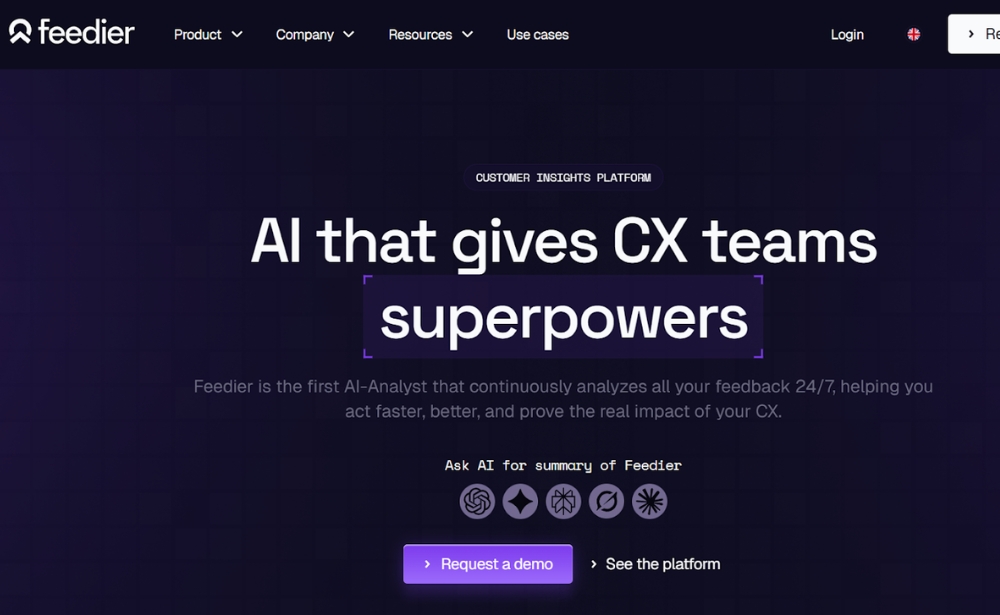
Feedier focuses on engagement-led feedback collection. It combines surveys with gamified elements and AI-generated summaries, which can help teams improve participation and simplify reporting. This can be useful in organisations where response rates are low or survey fatigue is a concern.
Feedier is often a good match when participation is the main challenge, while organisations that prioritise journey-level diagnostics, advanced digital targeting and feedback operations for UX and CRO workflows may prefer a platform built specifically for digital journey feedback and actionability.
Best for
Teams prioritising participation and engagement in feedback collection.
Where Feedier is useful
Feedier may be relevant for teams that prioritise more engaging survey formats, improving response rates, lighter AI-supported reporting and multi-channel survey collection.
Website: www.feedier.com
6) Skeepers
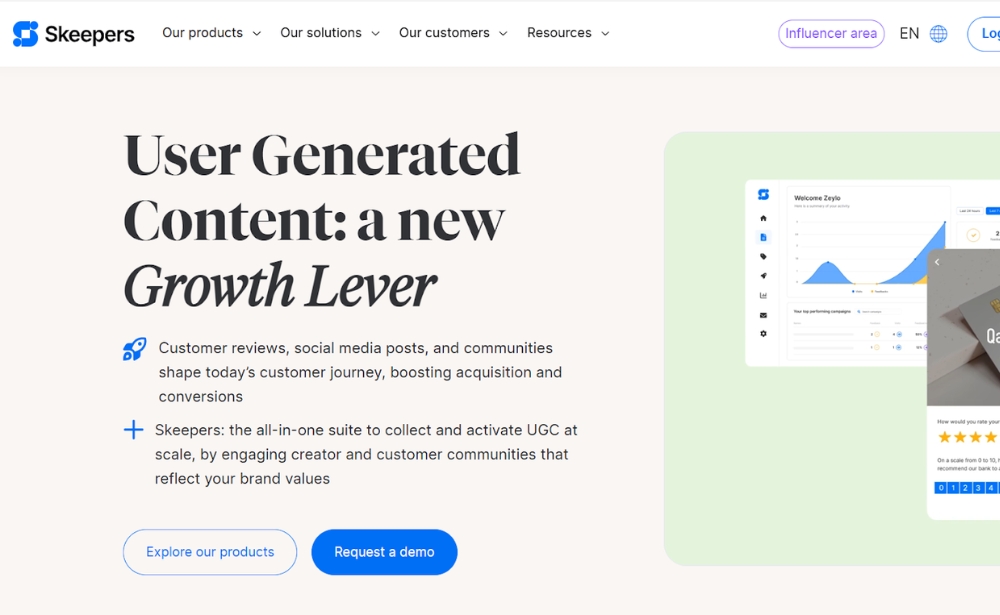
Skeepers operates in a broader customer engagement space, with offerings that include reviews, user-generated content, influencer-related capabilities and feedback components. Because of that, it is not a dedicated feedback platform in the same way as Qualtrics or Mopinion.
Skeepers can be relevant for organisations looking to combine reviews, trust-building and engagement initiatives in one ecosystem. If your priority is improving digital experiences through targeted feedback and actionable insight across digital journeys, it is often evaluated as a wider engagement and advocacy platform rather than a focused feedback intelligence solution.
Best for
Organisations looking to combine reviews, trust-building and engagement initiatives in one ecosystem.
Where Skeepers is useful
Skeepers may be relevant for organisations that want to combine ratings and reviews, customer advocacy and trust-building, engagement initiatives and feedback as part of a broader engagement ecosystem.
Website: www.skeepers.com
Final thoughts
Qualtrics remains one of the most comprehensive XM platforms on the market and for many large enterprises, it will continue to be a strong fit. In 2026, however, more European organisations are actively prioritising European solutions because they want providers that align naturally with EU regulations and procurement expectations, including GDPR and accessibility requirements such as WCAG and the European Accessibility Act.
If your priority is improving digital journeys, collecting feedback in context and helping UX, CRO and product teams act faster, Mopinion (part of Netigate) is one of the strongest European alternatives to consider. It gives organisations a digital feedback platform built for real journeys, strong support for optimisation teams, GDPR-aligned European operations, accessibility-aligned feedback collection and a clear path into broader CX and EX programmes through Netigate.
Ready to see Mopinion in action?
Want to learn more about Mopinion’s all-in-1 user feedback platform? Don’t be shy and take our software for a spin! Do you prefer it a bit more personal? Just book a demo. One of our feedback pro’s will guide you through the software and answer any questions you may have.