
Have you ever been asked to rate your experience after making an online purchase, using an app or contacting customer support? That is a customer experience (CX) survey: a direct way for businesses to understand how customers perceive individual interactions and their overall relationship with a brand.
Digital analytics can show businesses what customers do, such as abandoning a checkout or leaving a page. CX surveys help explain why those behaviours occur by revealing customer goals, expectations, frustrations and preferences.
When used effectively, customer experience surveys can help organisations identify friction, prioritise improvements and track whether changes are producing better outcomes. However, their value depends on asking the right questions at the right moment and turning the resulting insights into action.
TL;DR
- A customer experience survey measures how customers perceive a specific interaction or their overall relationship with a business.
- CSAT, NPS, CES and GCR measure different parts of the experience, including satisfaction, loyalty, effort and task completion.
- The most effective CX surveys are short, relevant and shown at the right moment in the customer journey.
- A metric alone rarely provides enough context. Adding a focused follow-up question helps explain why a customer selected a particular score.
- The value of a CX survey comes from what happens afterwards: analysing the results, identifying recurring problems and acting on the feedback.
In this guide, we explain what customer experience surveys are, why businesses use them and how the main CX metrics differ. We also cover practical survey questions, common benefits and the principles that help businesses collect more useful customer feedback.
Why is customer experience important?
Customer experience (CX) shapes how customers perceive your business and whether they choose to return. It includes every interaction across the customer journey, from visiting your website and using your product to completing a purchase or contacting customer support.
A positive experience can strengthen customer satisfaction, loyalty, advocacy and lifetime value. A frustrating or confusing experience, however, can lead to abandoned journeys, negative feedback and customer churn.
Improving CX therefore requires more than making assumptions about what customers want. Businesses need to understand where customers encounter friction, what they value and whether their needs are being met. Customer experience surveys provide a direct way to collect these insights and use them to improve individual interactions and the wider customer journey.
What is a customer experience survey?
A customer experience survey is a questionnaire used to understand how customers perceive a specific interaction or their overall relationship with a business. It can measure satisfaction, effort, loyalty, goal completion and other aspects of the customer journey.
CX surveys can be distributed through websites, mobile apps, email, SMS, support channels and other customer touchpoints. They can also be triggered automatically at relevant moments, such as after a purchase, during onboarding, following a support interaction or when a visitor is about to leave a website.
These surveys can take many forms, including rating scales, multiple-choice questions, sliders and open-text fields. Some focus on a particular transaction or experience, while others measure the customer’s broader relationship with the organisation over time.
The purpose is to identify customer needs, uncover friction, understand the reasons behind customer behaviour and determine where improvements will have the greatest impact.
Why use customer experience surveys?
Customer experience surveys help businesses understand what customers experience, why problems occur and where improvements are most needed. They replace assumptions with direct customer experience feedback collected at relevant moments across websites, mobile apps, email and other touchpoints.
By asking customers about a specific interaction, businesses can identify what is working well and where customers encounter friction. For example, a survey might reveal why visitors abandon the checkout process, struggle to find information or contact customer support instead of completing a task independently.
CX surveys can also be used to:
- Measure customer sentiment: Track satisfaction, effort, loyalty and goal completion using metrics such as CSAT, CES, NPS and GCR.
- Understand the reasons behind customer behaviour: Use follow-up and open-text questions to uncover why customers complete, abandon or struggle with a journey.
- Identify trends and recurring problems: Analyse feedback over time to find common themes across pages, products, devices, channels or customer segments.
- Inform product and service improvements: Use customer insights to prioritise changes such as simplifying checkout, improving mobile usability or introducing additional payment options.
- Evaluate the impact of CX initiatives: Compare results over time to determine whether changes have improved the customer experience.
However, collecting feedback is only useful when it leads to action. Businesses should share relevant insights with the teams responsible for the experience, follow up when necessary and address the root causes of recurring issues. This process is often referred to as closing the customer feedback loop.
Used consistently, customer experience surveys create an ongoing cycle of listening, learning and improvement rather than providing a one-time snapshot of customer opinion.
Benefits of customer experience surveys
Customer experience surveys give businesses the evidence they need to make more customer-focused decisions. When feedback is collected at the right moments and connected to action, it can support improvements across marketing, product development, customer service and digital experience.
Key benefits include:
- Understanding customer needs and expectations: CX surveys reveal what customers value, what they are trying to achieve and where their expectations are not being met.
- Improving customer satisfaction: Feedback helps businesses identify friction and make targeted changes to difficult, confusing or disappointing experiences.
- Strengthening customer loyalty: Responding to customer needs and resolving recurring problems can help businesses build customer loyalty and reduce the risk of churn.
- Prioritising improvements: Rather than relying on assumptions, teams can use survey data to determine which pages, features, processes or customer journeys require the most attention.
- Supporting product and service development: Feedback can uncover unmet needs, feature requests and changing preferences that inform future products, services and updates.
- Improving operational efficiency: Surveys can expose processes that create unnecessary customer effort or generate avoidable support requests, helping teams streamline the experience.
- Tracking performance over time: Consistently measuring metrics such as CSAT, CES and NPS helps businesses evaluate whether changes are improving the customer experience.
- Building a customer-focused culture: Sharing feedback across departments helps teams understand how their decisions affect customers and encourages greater accountability for the overall experience.
These benefits are not automatic, however. They depend on asking relevant questions, analysing the results in context and ensuring that insights reach the teams capable of acting on them.
Customer experience survey questions and metrics
Customer experience survey questions can measure satisfaction, loyalty, effort and task completion at different stages of the customer journey. The right question depends on what you want to understand and the interaction you are evaluating.
Four commonly used customer experience metrics are Customer Satisfaction Score (CSAT), Net Promoter Score (NPS), Customer Effort Score (CES) and Goal Completion Rate (GCR). Although these metrics are sometimes grouped together, each answers a different question about the customer experience.
1. Customer Satisfaction Score (CSAT)
Customer Satisfaction Score measures how satisfied customers are with a particular product, service or interaction. It is best used shortly after an experience, while the details are still fresh in the customer’s mind.
A standard CSAT question is:
“How satisfied are you with your experience today?”
Customers typically answer using a five-point scale ranging from “very dissatisfied” to “very satisfied.” According to Qualtrics’ CSAT methodology, the score is commonly calculated as the percentage of respondents who select one of the two most positive answers:
CSAT = number of satisfied responses ÷ total number of responses × 100
CSAT surveys can be used to evaluate experiences such as:
- Completing a purchase
- Using a website or mobile app
- Receiving customer support
- Completing onboarding
- Using a particular product or feature
To understand the reasons behind the score, add a focused follow-up question such as:
“What is the main reason for your rating?”
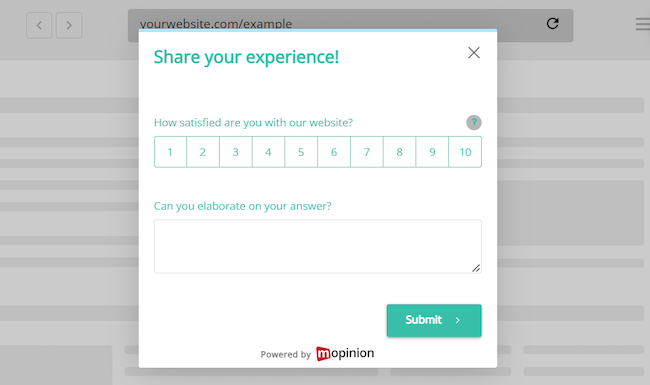
2. Net Promoter Score (NPS)
Net Promoter Score measures customer loyalty by asking how likely customers are to recommend a business, product or service.
The standard NPS question is:
“On a scale from 0 to 10, how likely are you to recommend [company, product or service] to a friend or colleague?”
Under the Net Promoter System developed by Bain & Company, respondents are divided into three groups:
- Promoters: Customers who give a score of 9 or 10
- Passives: Customers who give a score of 7 or 8
- Detractors: Customers who give a score between 0 and 6
The score is then calculated using the following formula:
NPS = percentage of promoters − percentage of detractors
NPS can be collected in two different contexts:
- Relationship NPS measures how customers perceive their overall relationship with the organisation. It is usually collected periodically from established customers.
- Transactional NPS asks customers to evaluate their willingness to recommend the business after a particular interaction, such as a purchase, delivery or support experience.
Because the numerical score does not explain why a customer chose it, an NPS survey should usually include a follow-up question such as:
“What is the main reason for your score?”

3. Customer Effort Score (CES)
Customer Effort Score measures how easy or difficult it was for a customer to complete a task or resolve an issue. It is particularly useful for identifying friction in transactional and task-oriented experiences.
A CES question might ask:
“How easy or difficult was it to complete your task today?”
Alternatively, customers may be asked whether they agree with a statement such as:
“The company made it easy for me to resolve my issue.”
CES can be collected after many different interactions, including:
- Completing checkout or making a payment
- Finding information on a website
- Using a self-service portal
- Completing onboarding
- Changing account information
- Returning a product
- Resolving a customer support request
The most suitable timing depends on the task being evaluated. The survey should generally appear immediately after the interaction so the customer can accurately recall the effort involved.
CES can be calculated as an average score or as the percentage of respondents who rated the experience as easy. Because organisations use different scales and calculation methods, it is important to apply the same approach consistently when comparing results over time.
A diagnostic follow-up question can reveal the source of unnecessary effort:
“What made completing this task difficult?”

4. Goal Completion Rate (GCR)
Goal Completion Rate measures whether users successfully achieved what they came to a website or mobile app to do. Unlike CSAT, NPS and CES, GCR is primarily a digital journey and task-success metric.
A simple GCR question is:
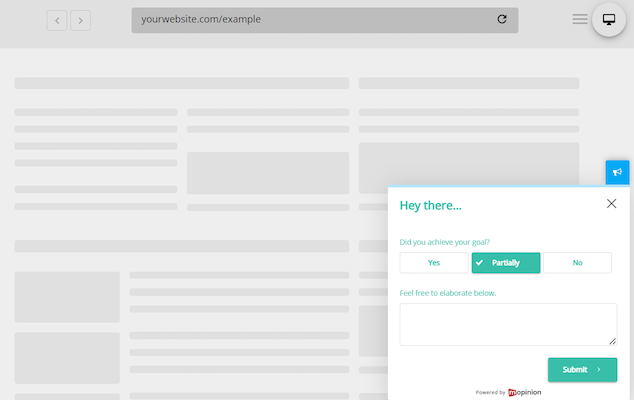
“Were you able to achieve your goal today?”
Respondents can select “yes,” “partly” or “no.” A basic completion rate can then be calculated as:
GCR = number of users who completed their goal ÷ total number of responses × 100
Goal completion can also be measured behaviourally through digital analytics, such as whether a visitor completed checkout, submitted an application or downloaded a document. A survey adds further context by revealing whether the user achieved their personal goal, which may not always match the conversion event tracked by analytics.
GCR surveys can be used across journeys such as:
- Purchasing a product
- Finding particular information
- Booking an appointment
- Submitting an application
- Managing an account
- Resolving a support issue
They can be displayed as passive, user-initiated feedback forms or triggered based on behaviour such as exit intent, an incomplete task or a completed journey. GCR can also be used on a homepage or landing page when visitors have a clear goal that can be evaluated, such as finding information or navigating to the right service.
When a customer does not achieve their goal, use a conditional follow-up question such as:
“What prevented you from achieving your goal?”
Contact details may also be requested when follow-up support is relevant, but the purpose should be clearly explained and the field should remain optional unless the information is genuinely necessary.
Which customer experience metric should you use?
The best metric depends on the question you want to answer:
- Use CSAT to understand whether customers were satisfied with an interaction.
- Use NPS to measure customer loyalty and willingness to recommend your organisation.
- Use CES to identify how much effort a task or interaction required.
- Use GCR to determine whether users successfully achieved their objective.
You do not necessarily need to choose only one. Different metrics can be used at different stages of the customer journey, provided each survey has a clear purpose and customers are not asked for feedback too frequently.
Give your customer experience the attention it deserves
Customer experience surveys can support customer loyalty, product development, digital optimisation and service improvement. However, the value does not come from collecting as many scores as possible. It comes from asking the right questions at the right moment, understanding the reasons behind the responses and turning those insights into action.
Once you have defined your survey objective, audience, questions and distribution strategy, the next step is choosing the right technology. Compare the available options in our overview of the best customer feedback tools.
Ready to see Mopinion in action?
Want to learn more about Mopinion’s all-in-1 user feedback platform? Don’t be shy and take our software for a spin! Do you prefer it a bit more personal? Just book a demo. One of our feedback pro’s will guide you through the software and answer any questions you may have.
Frequently Asked Questions
A customer experience survey is a questionnaire used to understand how customers perceive a specific interaction or their overall relationship with a business. It can measure satisfaction, loyalty, effort, goal completion and the reasons behind a customer’s experience.
Customer experience surveys help businesses identify friction, understand customer needs and prioritise improvements based on direct feedback rather than assumptions. They can also be used to track whether changes improve the experience over time.
A CX survey should include a primary measurement question, such as CSAT, NPS, CES or GCR, followed by a focused question asking why the customer selected that answer. The exact questions should reflect the interaction or journey being evaluated.
The most common CX survey metrics are Customer Satisfaction Score (CSAT), Net Promoter Score (NPS) and Customer Effort Score (CES). Digital teams may also use Goal Completion Rate (GCR) to measure whether users successfully achieved their objective.
CSAT measures satisfaction with an experience, NPS measures loyalty and willingness to recommend, and CES measures how easy or difficult it was to complete a task. The right metric depends on what the business wants to learn.
Transactional CX surveys should usually be shown shortly after the interaction being evaluated, such as a purchase, support conversation or onboarding step. Relationship surveys can be sent periodically to measure broader customer sentiment over time.
Most transactional CX surveys should contain two or three questions: one metric question, one diagnostic follow-up and, where relevant, an optional open-text field. Longer surveys may be appropriate for broader research, but unnecessary questions can reduce completion rates.
Customers should be surveyed often enough to capture meaningful feedback but not so frequently that the surveys become disruptive. Frequency controls, customer segmentation and suppression rules can help prevent the same person from repeatedly receiving survey requests.
Keep the survey short, display it at a relevant moment and explain why the feedback is being collected. Mobile-friendly design, simple language and questions that clearly relate to the customer’s recent experience can also improve participation.
Survey results should be analysed by score, response volume, open-text themes, customer segment, device, channel and stage of the journey. Businesses should also compare results over time and connect feedback with behavioural or operational data where possible.
Yes. AI can help categorise open-text responses, identify recurring topics, analyse sentiment and summarise large volumes of feedback. However, teams should still validate the results and use business context when deciding what action to take.
Businesses should share relevant insights with the responsible teams, investigate recurring problems and prioritise improvements. Where appropriate, they should also follow up with individual customers and measure whether the resulting changes improved the experience.