

Voice of the Customer (VoC) tools help organisations collect, analyse and act on customer feedback across different journeys, channels and touchpoints. The right Voice of the Customer software can reveal what customers need, where they experience friction and which improvements should be prioritised.
However, VoC platforms vary considerably. Some specialise in digital feedback collection, while others focus on enterprise experience management, survey programmes, contact centres or AI-powered feedback analysis.
In this guide, we compare 15 of the best Voice of the Customer tools for 2026, including their main capabilities, ideal use cases and important considerations.
TL;DR – Article summary
- Voice of the Customer tools help organisations collect, analyse and act on feedback across customer journeys and touchpoints.
- VoC software can capture feedback from websites, mobile apps, email campaigns, surveys, support interactions, reviews and other channels.
- Some platforms specialise in digital feedback collection, while others focus on enterprise experience management, survey programmes, contact centres or AI-powered feedback analysis.
- The best Voice of the Customer software depends on your feedback channels, company size, programme maturity, analysis needs and existing technology.
- A complete VoC platform should help teams gather relevant feedback, identify customer needs, share insights and turn feedback into action.
- When comparing VoC tools, organisations should consider targeting, customisation, qualitative analysis, reporting, integrations, security, governance and scalability.
In this blog, we’ll cover:
- What is Voice of the Customer software?
- How we selected the best Voice of the Customer tools
- The 15 best Voice of the Customer tools
- Voice of the Customer software vs survey software
- How to choose a Voice of the Customer tool
- Frequently asked questions about Voice of the Customer tools
- Find the right Voice of the Customer tool
What is Voice of the Customer software?
Voice of the Customer software helps organisations systematically collect, organise, analyse and act on customer opinions, expectations and experiences.
VoC data can come from direct sources such as customer surveys, website feedback forms, in-app surveys and interviews. It can also come from indirect sources such as support conversations, online reviews, social media, call transcripts and behavioural data.
A complete Voice of the Customer platform typically supports three stages:
- Collecting feedback across relevant channels and customer touchpoints
- Analysing feedback to uncover topics, sentiment, trends and experience drivers
- Taking action through dashboards, alerts, integrations and closed-loop workflows
This distinguishes VoC software from basic survey tools. A survey builder may help an organisation gather responses, but it does not always provide the targeting, analysis, programme management and action capabilities required for a mature Voice of the Customer programme.
How we selected the best Voice of the Customer tools
We assessed the tools in this guide according to their relevance to modern Voice of the Customer and customer experience programmes.
Our evaluation considered:
- Feedback collection channels
- Website, mobile and in-product feedback options
- Survey and feedback form capabilities
- Behavioural targeting
- Structured and open-text feedback analysis
- AI-powered analysis
- Dashboards and reporting
- Alerts and closed-loop workflows
- Integrations and APIs
- Enterprise scalability
- Privacy, security and governance
- Primary use case
The platforms are not ranked solely according to the number of features they offer. Each VoC tool is suited to a different type of organisation, customer journey or level of programme maturity.
The 15 best Voice of the Customer tools
The right Voice of the Customer platform depends on where you collect feedback, how much data you need to analyse and how customer insights will be used across your organisation
Below, we compare 15 VoC tools and explain their main capabilities, ideal use cases and potential considerations.
1. Mopinion (Part of Netigate)
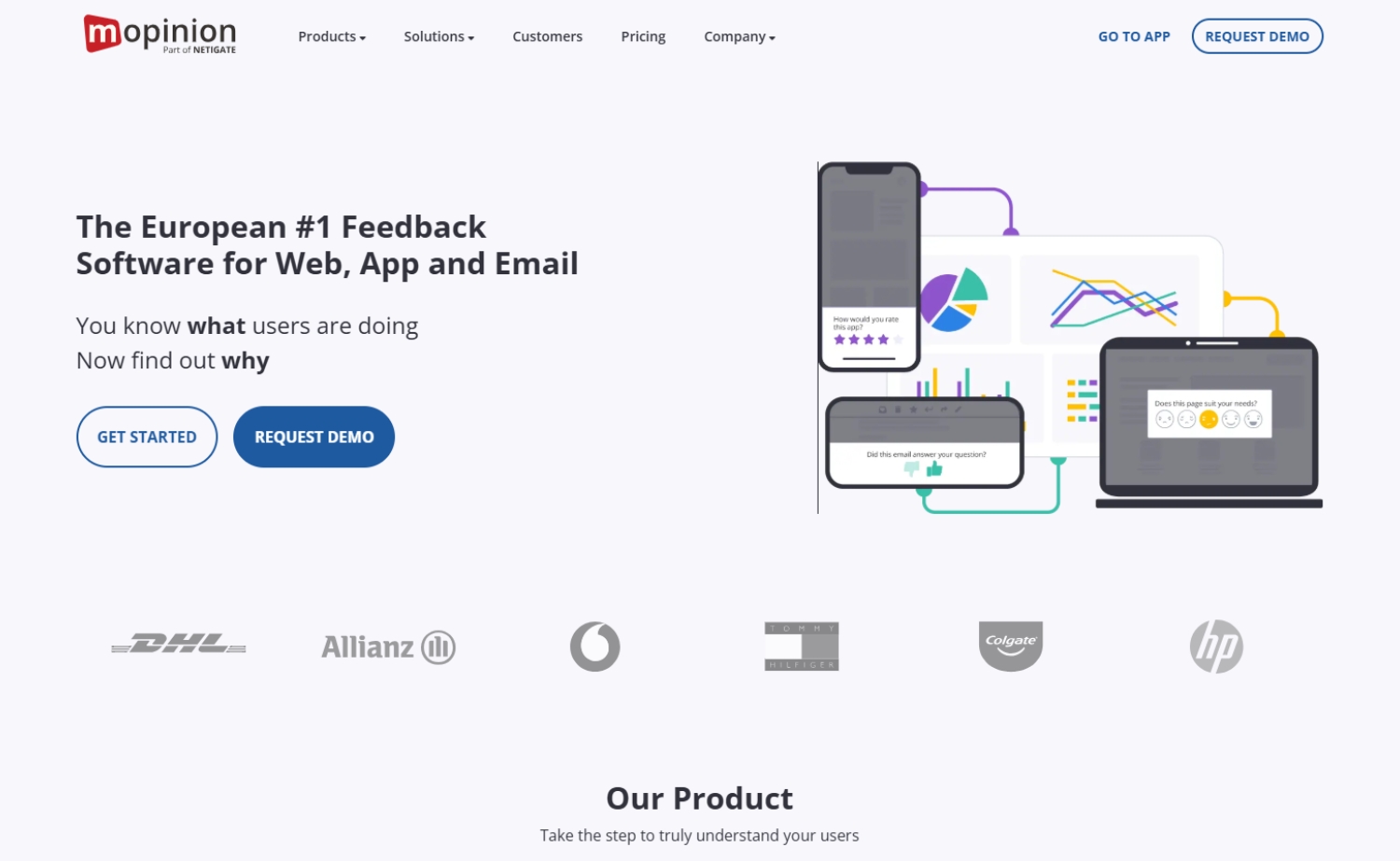
Mopinion, part of Netigate is a user feedback platform designed to help organisations understand and improve experiences across websites, mobile apps and email campaigns.
Teams can create customisable feedback forms and control where, when and for whom they appear. Feedback can be targeted according to factors such as the page a visitor is viewing, their device, behaviour, customer segment or stage in the journey.
This makes it possible to ask relevant questions at specific moments rather than showing every visitor the same general survey.
Once feedback has been collected, teams can analyse quantitative scores and open-text responses through dashboards, filters and reporting. Alerts and integrations can also help route important insights to the teams responsible for taking action.
Mopinion is particularly relevant to digital, ecommerce, product, UX, marketing and customer experience teams that want to understand why users succeed, struggle or abandon a digital journey.
Key features:
- Website feedback forms
- Mobile and in-app feedback
- Email campaign feedback
- Customisable form design
- Behavioural and journey-based targeting
- NPS, CSAT and CES surveys
- Open-text feedback analysis
- Custom dashboards and reports
- Alerts and integrations
- Support for multilingual feedback programmes
Interested? Start your free trial today or request a demo.
2. Netigate
Netigate is an experience management platform that helps organisations collect and analyse feedback from customers and employees.
Its customer experience capabilities can support relationship surveys, transactional feedback, satisfaction programmes and other structured Voice of the Customer initiatives. Organisations can use the platform to monitor key experience metrics, analyse customer comments and share findings through dashboards and reports.
Netigate is also designed to support employee experience programmes. This makes it relevant to organisations that want to manage CX and EX research within a broader experience management environment.
Together, Netigate and Mopinion can support both structured experience programmes and contextual digital feedback collection.
Key features:
- Customer experience surveys
- Employee experience surveys
- NPS, CSAT and other feedback metrics
- Survey distribution
- Open-text feedback analysis
- Dashboards and reporting
- Data segmentation
- Automated reports
- Experience programme management
- Enterprise security and governance options
Interested? Request a demo.
3. Qualtrics
Qualtrics is an enterprise experience management platform that supports customer, employee, product and brand experience programmes.
Its Voice of the Customer capabilities can help organisations collect feedback across surveys, digital channels, service interactions and other customer touchpoints. Teams can analyse experience data, monitor customer metrics and create workflows that distribute insights across the organisation.
Qualtrics is generally suited to large organisations managing multiple programmes, brands, regions or business units. It offers extensive configuration and governance options, but these capabilities may also require more implementation resources than a focused self-service feedback tool.
Key features:
- Omnichannel customer listening
- Website and mobile feedback
- Customer surveys
- Contact centre insights
- Text and sentiment analysis
- Customer journey insights
- Automated workflows
- Role-based dashboards
- Enterprise access controls
- Customer and employee experience management
Website: www.qualtrics.com
4. Medallia
Medallia is an enterprise experience management platform designed to capture and analyse customer signals across a wide range of interactions.
It can combine survey feedback with data from digital channels, customer service conversations and operational systems. This enables organisations to examine customer journeys across several touchpoints rather than assessing each interaction in isolation.
Medallia is particularly relevant to global organisations, multi-location businesses and companies with complex operational structures. Its capabilities extend across customer experience, employee experience, contact centres and digital interactions.
Key features:
- Omnichannel experience data
- ustomer survey management
- Digital experience insights
- Speech and text analytics
- Journey-level analysis
- Alerts and case management
- Enterprise dashboards
- Customer segmentation
- Operational data connections
- Enterprise governance
Website: www.medallia.com
5.InMoment
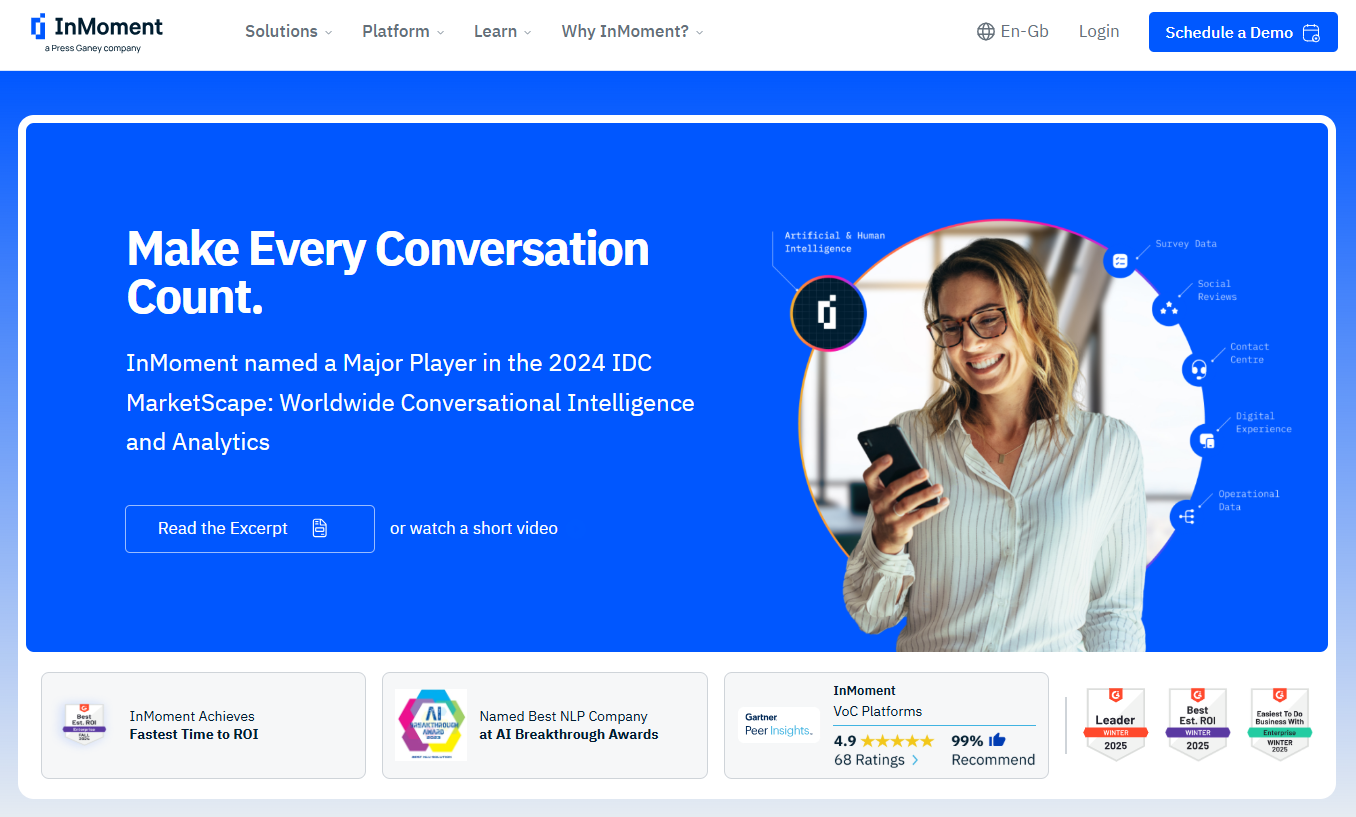
InMoment is a customer experience platform that helps organisations bring together structured survey responses and unstructured customer feedback.
The platform can be used to analyse information from sources such as surveys, reviews, customer conversations and other experience channels. Its analytics help organisations identify themes, customer sentiment and recurring experience issues.
InMoment also provides customer experience consulting and programme support, making it relevant to organisations seeking both technology and strategic guidance.
Key features:
- Omnichannel customer feedback
- Structured and unstructured data analysis
- Survey management
- Text analytics
- Customer journey insights
- Experience dashboards
- Closed-loop workflows
- Review and reputation data
- Customer segmentation
- X programme services
Website: www.inmoment.com
6.Forsta
Forsta provides technology for customer experience, market research and customer interaction analysis.
Its platform can support surveys, multichannel feedback, reporting and research programmes.
Organisations can bring together information from customer questionnaires, digital interactions, service conversations and other sources.
Forsta is particularly relevant to companies and research teams that want to combine Voice of the Customer insights with more advanced research methodologies and reporting.
Key features:
- Voice of the Customer surveys
- Market research capabilities
- Multichannel feedback
- Contact centre insights
- Interactive dashboards
- Reporting and data visualisation
- Text and sentiment analysis
- Survey programme management
- Research workflows
- Data integrations
Website: www.forsta.com
7. Verint Voice of the Customer
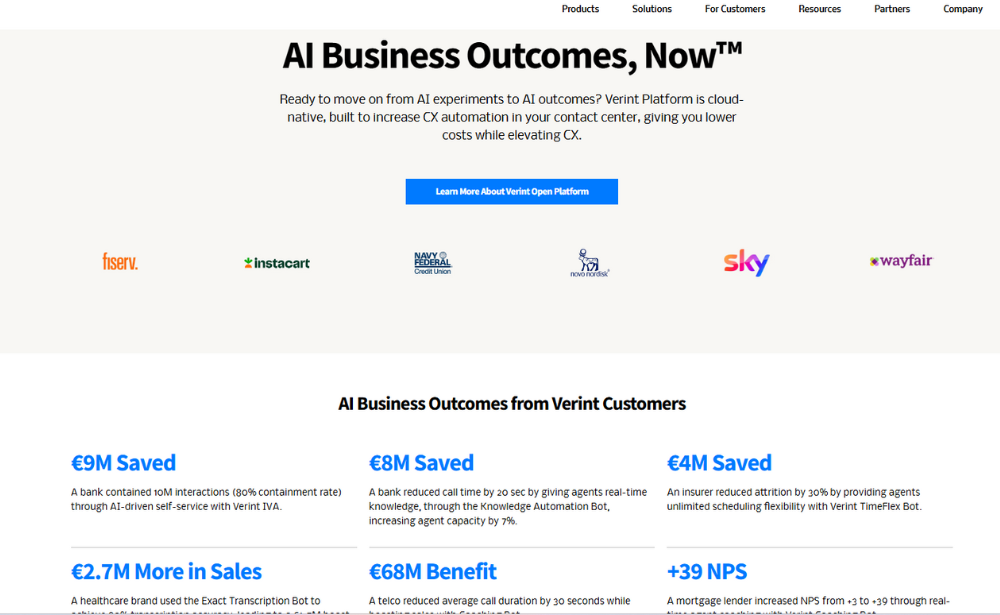
Verint provides Voice of the Customer capabilities that connect customer feedback with service, contact centre and digital interaction data.
The platform can combine surveys with information from calls, digital conversations and customer service interactions. Text and speech analytics help organisations identify common topics, service issues and drivers of satisfaction or dissatisfaction.
Verint is particularly relevant to organisations that want to link their VoC programme closely to contact centre operations, workforce processes and customer service improvement.
Key features:
- Customer surveys
- Speech analytics
- Text analytics
- Contact centre data
- Digital interaction insights
- Customer service analytics
- Experience dashboards
- Automated analysis
- Alerts and workflows
- Enterprise integrations
Website: www.verint.com
8. NiCE Feedback Management
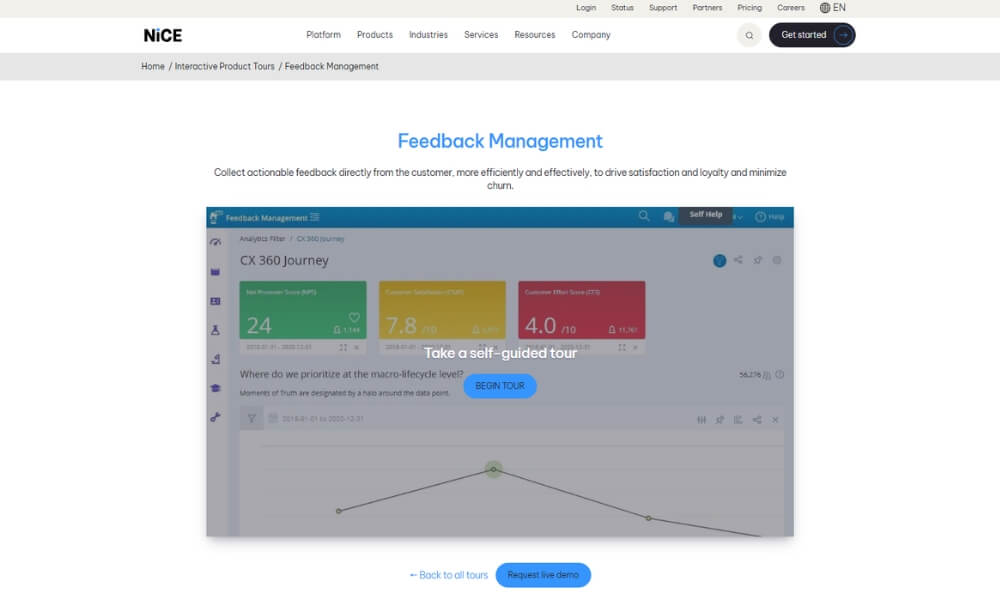
NiCE provides feedback management capabilities designed to connect customer feedback with contact centre interactions and operational performance.
Organisations can request feedback following service interactions and use the resulting insights to monitor customer satisfaction, evaluate service quality and support agent improvement.
The platform is especially relevant to organisations already using NiCE technology or those that want feedback management to sit close to their customer service infrastructure.
Key features:
- Post-interaction surveys
- Contact centre feedback
- Voice and digital survey channels
- Customer satisfaction measurement
- Operational reporting
- Agent-level insights
- Alerts and workflows
- Customer service analytics
- Contact centre integrations
- Enterprise controls
Website: www.nice.com
9. Chattermill
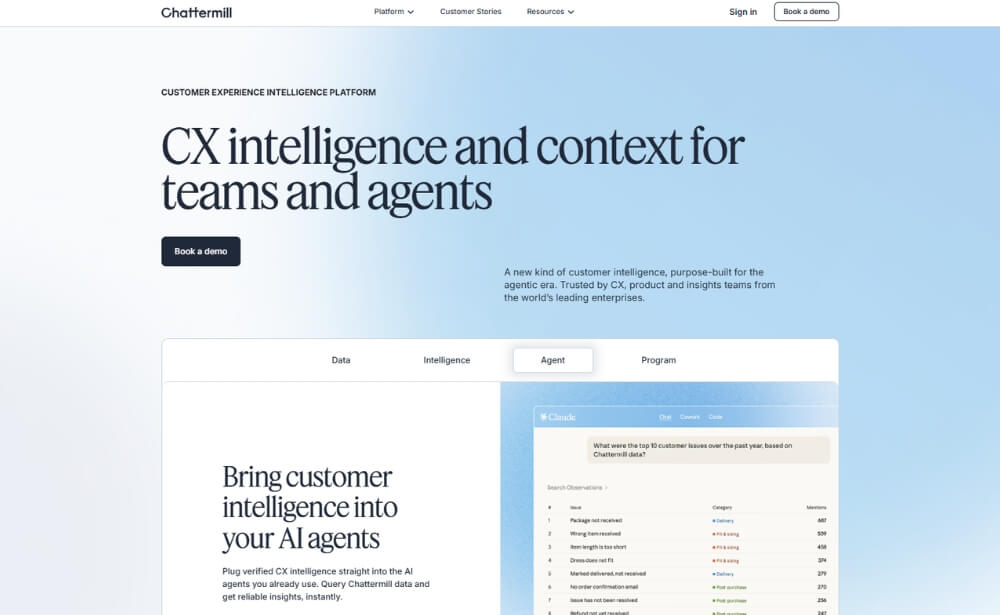
Chattermill is a customer experience intelligence platform focused on consolidating and analysing unstructured customer data.
It can bring together information from surveys, online reviews, support tickets, social media, customer conversations and other sources. AI-powered analysis can then identify topics, sentiment and recurring customer experience issues.
Rather than concentrating primarily on survey creation, Chattermill is most relevant to organisations that already collect large volumes of customer feedback and need a scalable way to understand it.
Teams can use its insights to investigate potential connections between customer themes and measures such as satisfaction, loyalty, retention or revenue.
Key features:
- Feedback consolidation
- AI-powered text analysis
- Topic and theme detection
- Sentiment analysis
- Survey response analysis
- Support ticket analysis
- Review analysis
- Multilingual feedback analysis
- Trend monitoring
- Business impact analysis
Website: www.chattermill.com
10. SurveySparrow
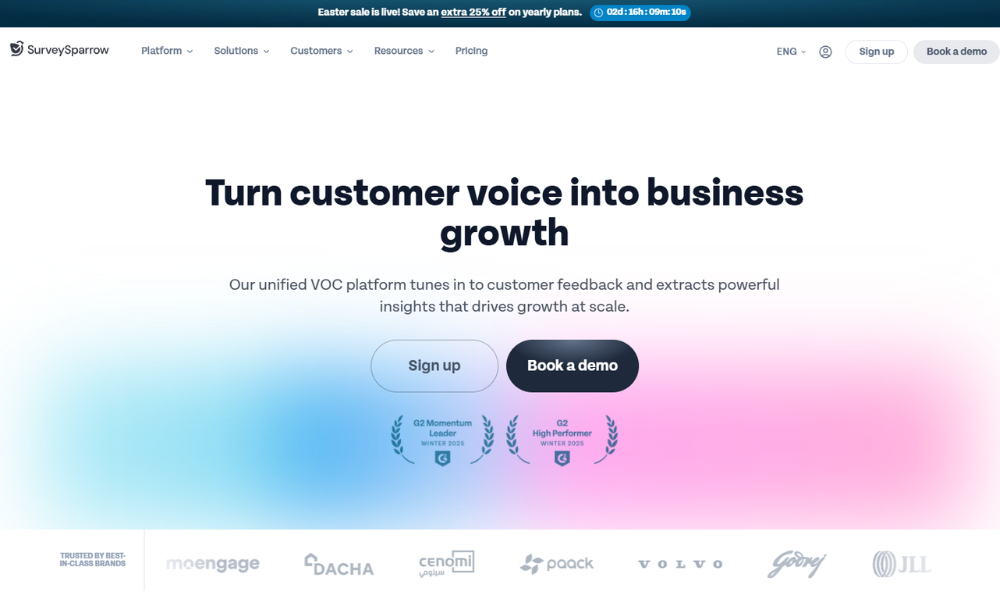
SurveySparrow is a survey and experience management platform known for its conversational survey formats.
Teams can use it to create and distribute customer surveys across multiple channels. It supports programmes involving NPS, CSAT, CES and other customer experience metrics, as well as survey automation and reporting.
SurveySparrow can be a practical option for organisations that need more functionality than a basic survey builder but are not ready to implement a large enterprise experience management platform.
Key features:
- Conversational surveys
- NPS, CSAT and CES programmes
- Multiple survey distribution channels
- Survey automation
- ustomer journey surveys
- Dashboards and reports
- Survey logic
- Integrations
- Customer follow-up
- Experience workflows
Website: www.surveysparrow.com
11. Survicate
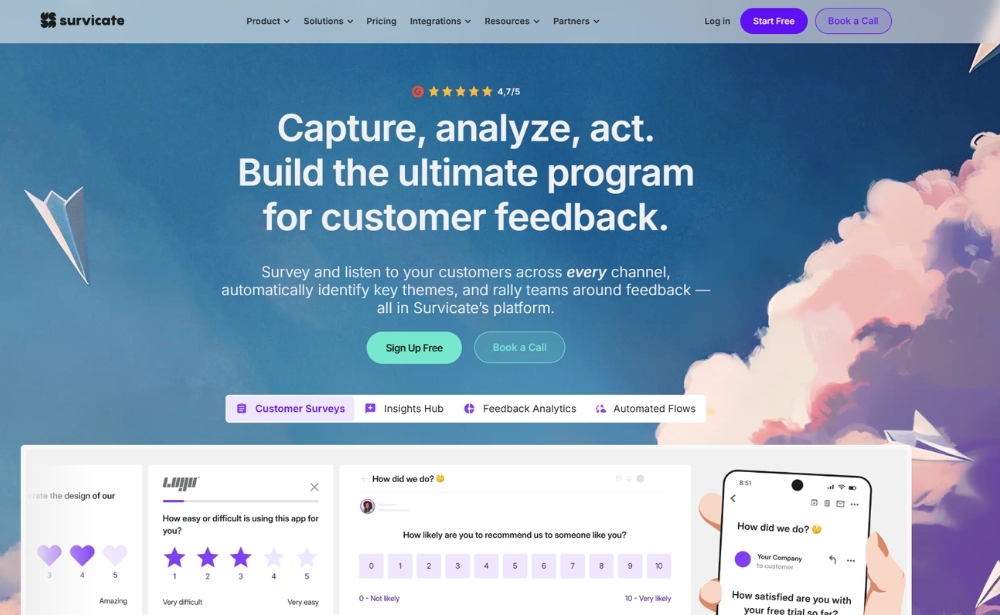
Survicate is a customer feedback platform that helps teams collect insights across websites, digital products, mobile apps, email and shareable survey links.
It supports both quantitative and qualitative feedback and can be used to run NPS, CSAT, CES, product research and website experience surveys.
Survicate connects with a range of CRM, marketing, support and product tools, making it relevant to SaaS companies and digital product teams that want feedback to fit into their existing technology stack.
Key features:
- Website surveys
- In-product surveys
- Mobile app surveys
- Email surveys
- Shareable survey links
- NPS, CSAT and CES
- Feedback analysis
- Survey templates
- CRM integrations
- Product and marketing integrations
Website: www.survicate.com
12. AskNicely
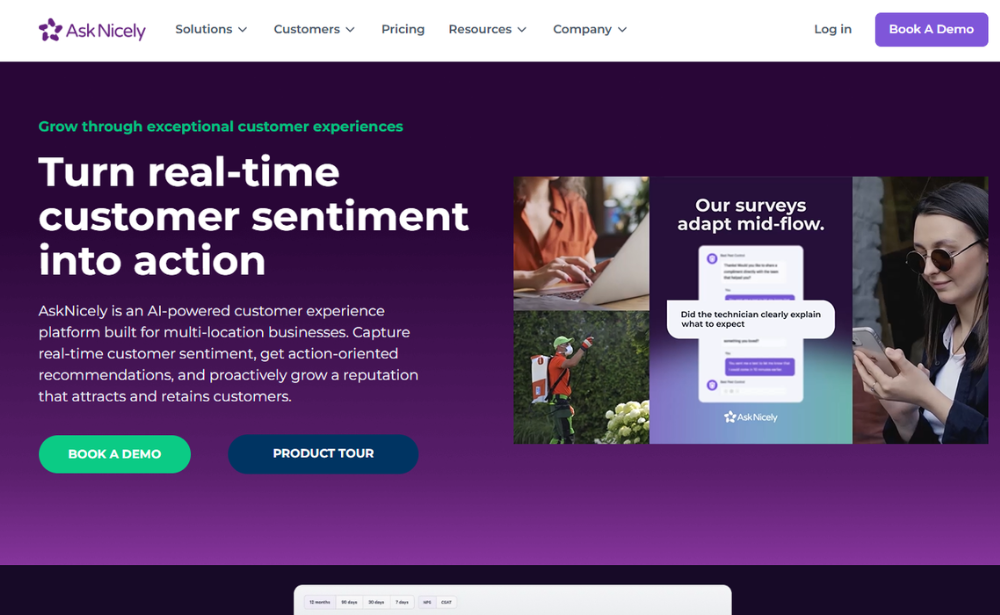
AskNicely is a customer experience platform focused on continuous feedback, NPS measurement and frontline action.
It helps service organisations request feedback after customer interactions and distribute the resulting insights to the teams and employees responsible for the experience.
Customer feedback can be connected to coaching, recognition and follow-up processes. This makes the platform particularly relevant to companies with branches, locations, service teams or other frontline employees.
Key features:
- NPS surveys
- CSAT surveys
- Automated survey distribution
- Frontline dashboards
- Customer follow-up
- Recognition workflows
- Coaching workflows
- CRM integrations
- Location-level reporting
- Team performance insights
Website: www.asknicely.com
13. Alchemer
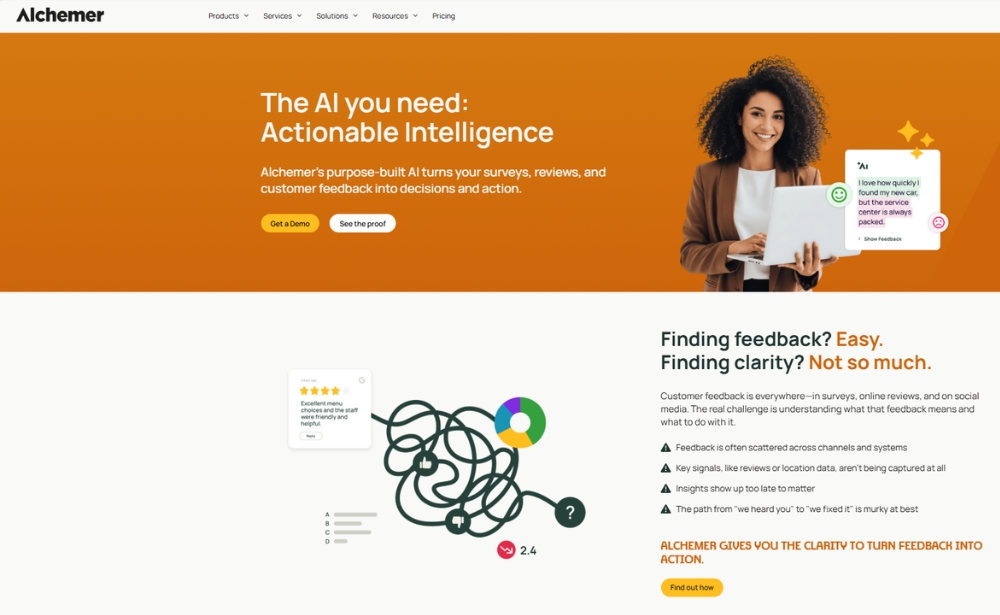
Alchemer is a survey and feedback platform that helps organisations collect information and connect feedback with operational processes.
It offers survey design, logic, distribution, integrations and workflow capabilities. This enables teams to use responses not only for reporting but also to trigger actions in other systems.
Alchemer can support customer experience, product feedback, market research and operational feedback programmes.
Key features:
- Customisable surveys
- Advanced survey logic
- Multiple distribution methods
- Workflow automation
- Dashboards and reporting
- APIs and integrations
- Product feedback
- Customer experience surveys
- Data exports
- Enterprise security options
Website: www.alchemer.com
14. Feedier
Feedier is an experience management platform that helps organisations consolidate direct customer feedback, indirect feedback and related business data.
The platform is designed to give CX teams context around customer responses rather than presenting survey scores in isolation. Its dashboards and analytics can help organisations compare feedback across customer groups, journeys and operational variables.
Feedier may be especially useful for organisations that want to examine customer experience information alongside account, segment or performance data.
Key features:
- Direct and indirect feedback
- Experience data consolidation
- Customer segmentation
- Visual analytics
- Feedback dashboards
- Automated insights
- Customer journey information
- Alerts
- Business data connections
- Experience reporting
Website: www.feedier.com
15. SentiSum
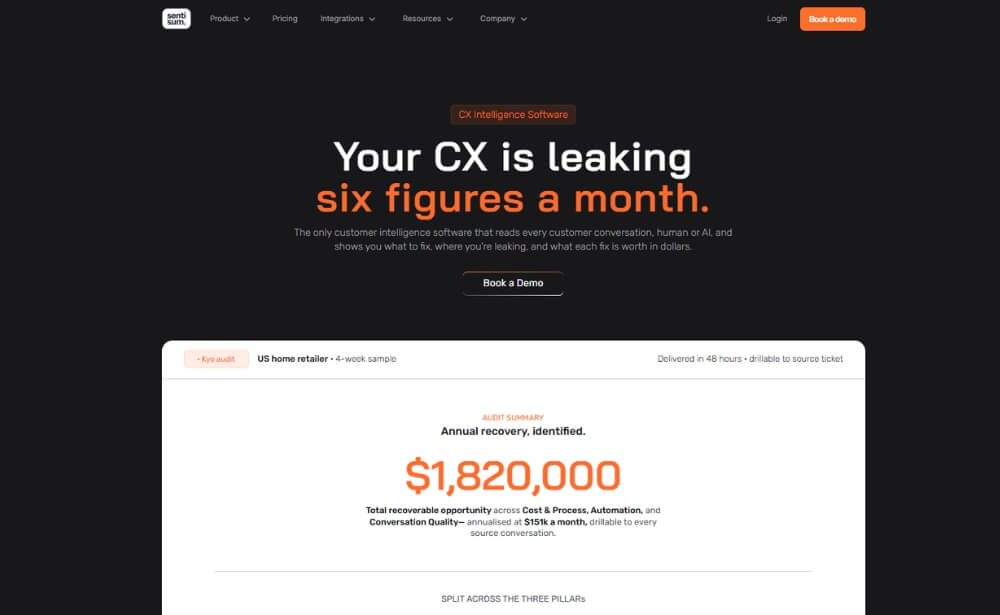
SentiSum is a customer feedback analytics platform focused on customer service data and support conversations.
It uses AI to analyse sources such as support tickets, survey comments, reviews and customer messages. This can help teams identify recurring contact reasons, product problems, customer sentiment and common sources of dissatisfaction.
SentiSum is particularly relevant to companies with high volumes of support interactions that would be difficult to categorise and review manually.
Key features:
- Support ticket analysis
- AI topic detection
- Sentiment analysis
- Contact reason identification
- Survey comment analysis
- Review analysis
- Automated categorisation
- Trend monitoring
- Customer support integrations
- Service quality insights
Website: www.sentisum.com
Voice of the Customer software vs survey software
Voice of the Customer software and survey software overlap, but they are not always the same.
A survey tool primarily helps an organisation create questionnaires, distribute them and review the responses. This may be enough for one-off research, event feedback or a simple customer satisfaction survey.
A Voice of the Customer platform usually supports a broader and more continuous programme. In addition to surveys, it may collect or consolidate feedback from digital journeys, mobile apps, email, service interactions, reviews, calls and customer support systems.
VoC software also tends to provide more advanced capabilities for:
- Combining multiple feedback sources
- Targeting feedback requests
- Identifying topics and sentiment
- Monitoring experience trends
- Connecting feedback to customer data
- Alerting teams to urgent issues
- Assigning follow-up actions
- Closing the feedback loop
- Sharing insights across departments
Tools such as Google Forms, Typeform and Jotform can be useful for creating questionnaires. However, they should not automatically be considered direct alternatives to dedicated Voice of the Customer platforms.

How to choose a Voice of the Customer tool
The best Voice of the Customer tool is not necessarily the platform with the longest feature list. It is the platform that supports your organisation’s specific customer feedback goals, channels and workflows.
1. Define what you want to improve
Start by identifying the business problem behind your Voice of the Customer programme.
For example, your organisation may want to:
- Improve website conversion
- Reduce customer churn
- Understand product satisfaction
- Improve mobile app usability
- Monitor customer service quality
- Identify recurring complaints
- Measure NPS or CSAT
- Improve customer onboarding
- Understand abandonment
- Evaluate the complete customer journey
Your objective will determine which feedback methods and analysis capabilities matter most.
2. Identify your most important feedback channels
Consider where customers interact with your organisation and where they are most likely to provide useful feedback.
Potential feedback sources include:
- Websites
- Mobile apps
- Digital products
- Email campaigns
- Customer surveys
- Support tickets
- Live chat
- Contact centre calls
- Online reviews
- Social media
- Physical locations
A digital-first business may prioritise website and in-app feedback, while a service-led organisation may need stronger contact centre and post-interaction survey capabilities.

3. Decide whether you need collection, analysis or both
Some organisations already collect large amounts of customer feedback but struggle to analyse it.
Others have strong analytics capabilities but lack an effective way to ask customers for feedback at relevant moments.
Determine whether your main requirement is:
- Collecting new customer feedback
- Consolidating existing feedback
- Analysing qualitative responses
- Distributing insights
- Closing the feedback loop
- Managing the complete process
This distinction will help you avoid selecting a tool that only solves one part of the problem.
4. Evaluate targeting and personalisation
A general customer survey cannot answer every customer experience question.
For digital journeys, consider whether the software can display different feedback forms according to:
- Page or screen
- Visitor behaviour
- Device type
- Customer segment
- Journey stage
- Previous actions
- Survey history
- Entry source
- Exit or abandonment behaviour
Relevant targeting helps teams collect more useful feedback while reducing unnecessary survey interruptions.
5. Review qualitative feedback analysis
Metrics such as NPS, CSAT and CES can indicate whether an experience is performing well. Open-text feedback often explains why.
Look for capabilities such as:
- Text analytics
- Topic detection
- Sentiment analysis
- AI-generated summaries
- Automatic categorisation
- Trend identification
- Multilingual analysis
- Connections between comments and customer metrics
These capabilities become increasingly important as the volume of customer feedback grows.

6. Check reporting and segmentation
A useful VoC platform should make it easy to analyse feedback according to relevant customer and experience variables.
Consider whether teams can filter or compare results by:
- Customer segment
- Journey stage
- Product
- Page
- Device
- Country
- Language
- Account type
- Survey
- Time period
Dashboards should also be accessible to the teams that need the insights, rather than requiring a specialist to create every report.
7. Assess integrations and action workflows
Customer feedback creates value when it reaches the people who can act on it.
Check whether the platform connects with your existing:
- CRM
- Customer support platform
- Product analytics tools
- Web analytics tools
- Project management software
- Collaboration tools
- Marketing automation platform
- Data warehouse
- Business intelligence software
Alerts, APIs, webhooks and case management workflows can help turn feedback into operational action.

8. Review privacy, security and governance
Enterprise organisations and public-sector bodies may have strict requirements regarding data storage, access, privacy and procurement.
Review areas such as:
- GDPR compliance
- Data hosting locations
- Security certifications
- User roles and permissions
- Single sign-on
- Data retention controls
- Audit capabilities
- Data processing agreements
- Vendor access controls
These factors should be assessed early in the selection process.
9. Match the platform to your VoC maturity
A team launching its first website survey has different needs from an international organisation managing hundreds of feedback programmes.
Choose a platform that supports your current programme while leaving enough room to expand. At the same time, avoid investing in enterprise complexity that your teams are unlikely to use.
Find the right Voice of the Customer tool
There is no single Voice of the Customer platform that will suit every organisation.
Enterprise experience management platforms can support complex, cross-departmental programmes. Contact centre tools connect feedback with service operations, while feedback analytics platforms help organisations interpret large volumes of customer comments and conversations.
For digital-first organisations, the ability to collect contextual feedback during the customer journey is particularly important. Website analytics may show where users abandon a journey, but direct feedback can explain why.
Mopinion by Netigate helps digital teams collect and analyse feedback across websites, mobile apps and email campaigns. With customisable forms, behavioural targeting, dashboards and integrations, organisations can understand customer needs and act on the moments that matter most.
Frequently asked questions about Voice of the Customer tools
A Voice of the Customer tool is software that helps organisations collect, analyse and act on customer feedback. It may gather or consolidate feedback from surveys, websites, mobile apps, email campaigns, online reviews, contact centres, support conversations and other customer touchpoints.
The best Voice of the Customer software depends on your organisation’s goals, customer channels, feedback volume and programme maturity. Digital teams may prioritise contextual website and app feedback, while enterprise CX teams may need omnichannel listening, advanced analytics and cross-departmental workflows.
Voice of the Customer software should include relevant feedback collection methods, customisable surveys or forms, dashboards, qualitative analysis, segmentation, integrations and tools for turning insights into action. More advanced platforms may also offer behavioural targeting, AI-powered summaries, sentiment analysis and closed-loop workflows.
Customer feedback refers to individual comments, opinions and scores shared by customers. Voice of the Customer is the broader process of systematically collecting this feedback, combining it with other customer signals and using the insights to guide decisions across the organisation.
Voice of the Customer focuses on understanding customer needs, expectations and perceptions. Customer experience management, or CXM, is the wider discipline of designing, monitoring and improving the complete customer experience. VoC insights are an important part of a CXM strategy.
NPS is a customer experience metric rather than a complete Voice of the Customer tool. It measures how likely customers are to recommend an organisation. A VoC platform may use NPS alongside CSAT, CES, open comments, behavioural data and other customer signals.
Yes. Many modern Voice of the Customer tools use text analytics and AI to summarise comments, identify topics, detect sentiment and uncover recurring issues. These capabilities help teams understand why customer experience metrics are changing without manually reviewing every response.
Survey software can support the feedback collection stage of a Voice of the Customer programme. However, more mature programmes may also require multichannel data, behavioural targeting, advanced analysis, integrations, alerts and action workflows that a basic survey tool may not provide.
Voice of the Customer software may be used by customer experience, digital, UX, product, marketing, ecommerce, research, customer service and data teams. Effective VoC programmes make relevant customer insights accessible across departments rather than limiting feedback to one team.
Start by defining a clear business objective and identifying the customer journeys or touchpoints you want to understand. Select suitable feedback methods, decide how results will be analysed and assign responsibility for taking action. Begin with a focused use case before expanding the programme across additional channels and teams.
AI can help organisations categorise open-text feedback, identify topics, detect sentiment, summarise large response sets and uncover trends. This reduces the manual work required to analyse qualitative feedback, although teams should still review important findings and apply business context before taking action.
Ready to see Mopinion in action?
Want to learn more about Mopinion’s all-in-1 user feedback platform? Don’t be shy and take our software for a spin! Do you prefer it a bit more personal? Just book a demo. One of our feedback pro’s will guide you through the software and answer any questions you may have.