

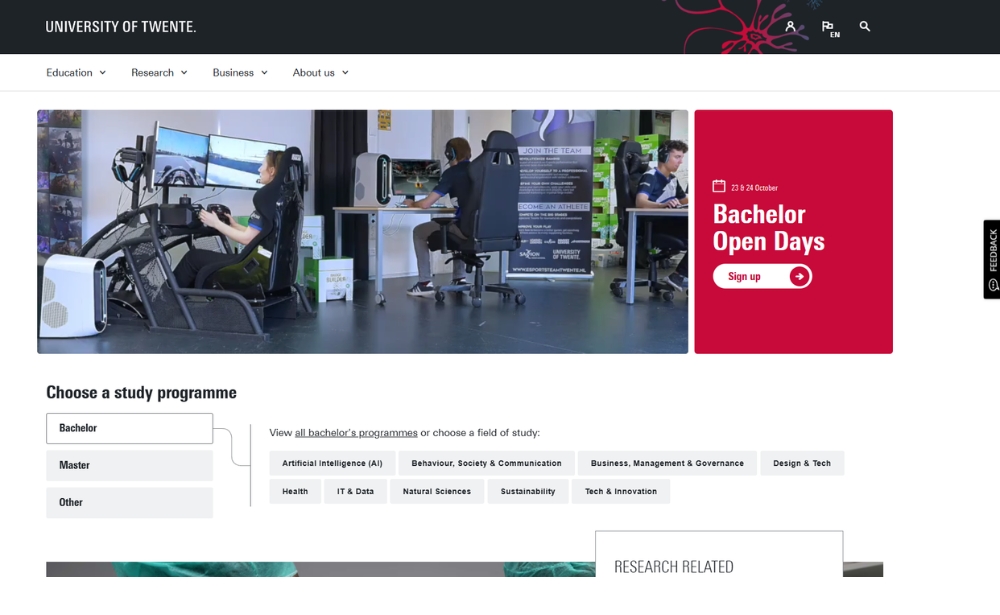
For any university with students, researchers and employees from all over the world, the website is one of the most important communication channels. It is often the first point of contact for prospective students, current students, employees, researchers and many other visitors.
For the University of Twente, this means the website needs to be accurate, accessible and easy to use.
With more than 50,000 pages, including study programme websites, research department pages, research project pages and administrative information, keeping the website up to date and easy to navigate is a continuous challenge.
To support this process, the University of Twente uses Mopinion’s digital feedback solution to optimise its website experience and turn visitor input into actionable improvements.
As Senior Communication Advisor and Product Owner of the website systems at the University of Twente, Anne Heining is closely involved in managing and improving the university’s digital channels. She has a background in Communication Studies and Psychology, with a focus on Cognitive Ergonomics.
For Anne and her team, the website plays a central role in how the university supports and informs its many audiences.
“As a university with students from all over the world, the website is our main communication channel,” Anne explains. “It’s their first point of contact with us, and it just needs to work as perfectly as possible.”

A website with many different visitors
The University of Twente’s website serves many different types of visitors.
Prospective students may use the website to explore study programmes, check admission requirements or learn more about the university. Current students, employees, researchers and external visitors may be looking for practical information, research content, project details or administrative processes.
Because of this, there is no single typical online visitor. The website needs to support many different journeys, from choosing a study programme to finding practical, research-related or administrative information.
“We have a website with more than 50,000 pages, because every study programme has a sub-website and every research department has one too,” Anne says. “There are also a lot of pages for research projects and administrative processes at the university.”
At that scale, even small issues can affect the user experience. That makes it important for visitors to have a simple way to report something when it is missing, unclear or not working as expected.
“That makes it extremely challenging, and extremely important, to give users an easy option to report issues,” Anne adds. “Because with so many pages, there are always issues.”
The challenge of managing website quality at scale
For the University of Twente, the need for digital feedback software came from the size and structure of the website.
At this scale, maintaining website quality is not only a content challenge, but also an organisational one. Many people contribute to the website, which means the team needs a clear process for identifying and following up on issues.
“We have 50,000 pages, but we also have 1,500 editors within the different departments at the university,” Anne explains. “They are not all experts, and sometimes things break. That makes it extremely important to have a good way of reporting issues.”
Before using Mopinion, the University of Twente was already working with another digital feedback solution. However, the team preferred to move to a European solution that was easy to use, worked well and felt like a future-proof choice.
“We preferred a European solution,” Anne says. “We saw some organisations moving to Mopinion, tested it and found Mopinion to be a European solution that works great.”
Ease of use, strong value for money and the fact that Mopinion is European were all important factors in the decision.
Why Mopinion was the right fit
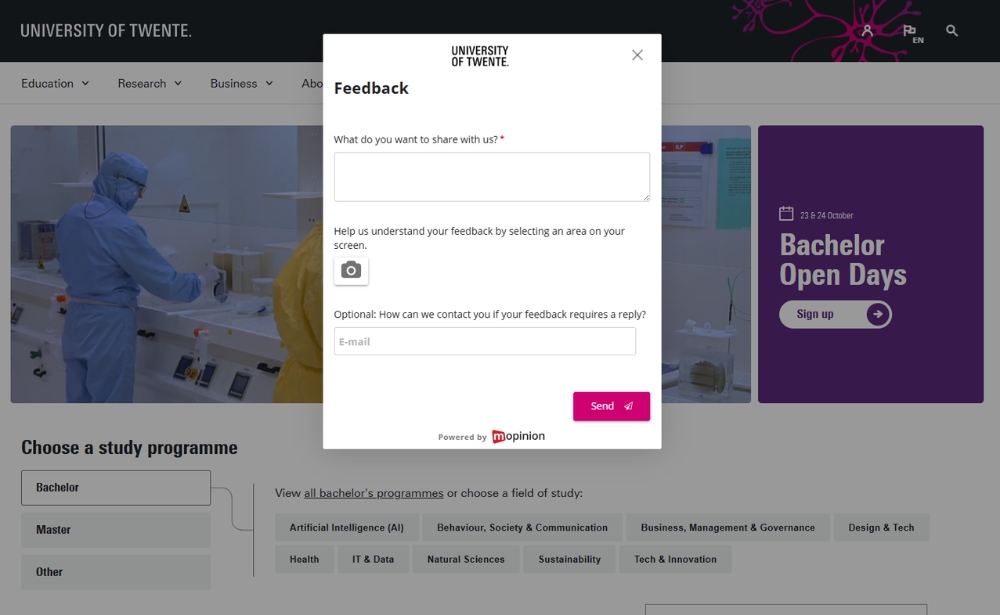
When choosing a digital feedback solution, the University of Twente needed something that would work well for a large and decentralised organisation.
With thousands of pages, many website sections and different teams involved, the product needed to be practical, user-friendly and easy to manage across departments and projects.
“Mopinion stood out because it offered the team a European solution that was simple to implement, easy to work with and aligned with the university’s expectations around data privacy and reliability”.
For a large public organisation like the University of Twente, this also meant working with a partner that understands the European digital landscape and provides a clear way to manage feedback across a complex website environment.
For Anne, ease of use was one of the main reasons Mopinion was a good fit.
“We have some other minor project sites that also use Mopinion, but they are in charge of their own part,” Anne says. “And that works fine, as Mopinion is just easy to use.”
The implementation process was also straightforward. The team was able to manage the setup independently, while knowing support was available if needed. This gave the University of Twente the flexibility to get started in a way that suited their own processes and internal setup.
“We just arranged everything ourselves,” Anne explains. “We did not use the option to help us get started because everything was really easy to set up.”
This made it possible for the University of Twente to start collecting feedback quickly and continue managing it in a way that fits the organisation.
Turning feedback into action
The main goal of collecting digital feedback at the University of Twente is clear: helping the team turn visitor input into actionable insights, route feedback to the right people and keep the quality of the website under control.
“With the large number of pages and website editors we have, we use the software to keep up the quality of the pages,” Anne explains. “And we get a lot of feedback every day. We read every single response and directly try to fix it.”
For the main university website, Anne works with two colleagues who support website users. Other smaller project sites also use Mopinion, but those teams manage their own feedback.
With Mopinion, the University of Twente can manage incoming feedback in a structured way and make sure each response reaches the right person or team.
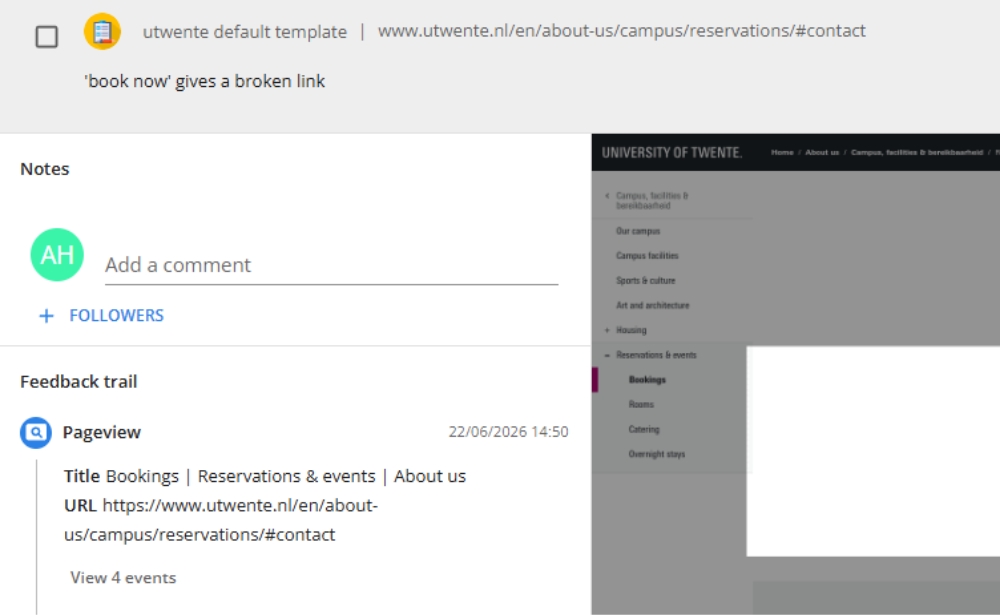
“Our colleagues who support website users get all the feedback and split it,” Anne explains. “If it is related to content issues, like broken links, we forward it to the website editors for those pages. If it is more technically related, it is passed on to my colleague and me, as we are in charge of developing the content management system.”
This process helps the University of Twente act on feedback in a structured way and make sure the right information reaches the right people.
Using targeted surveys on specific pages
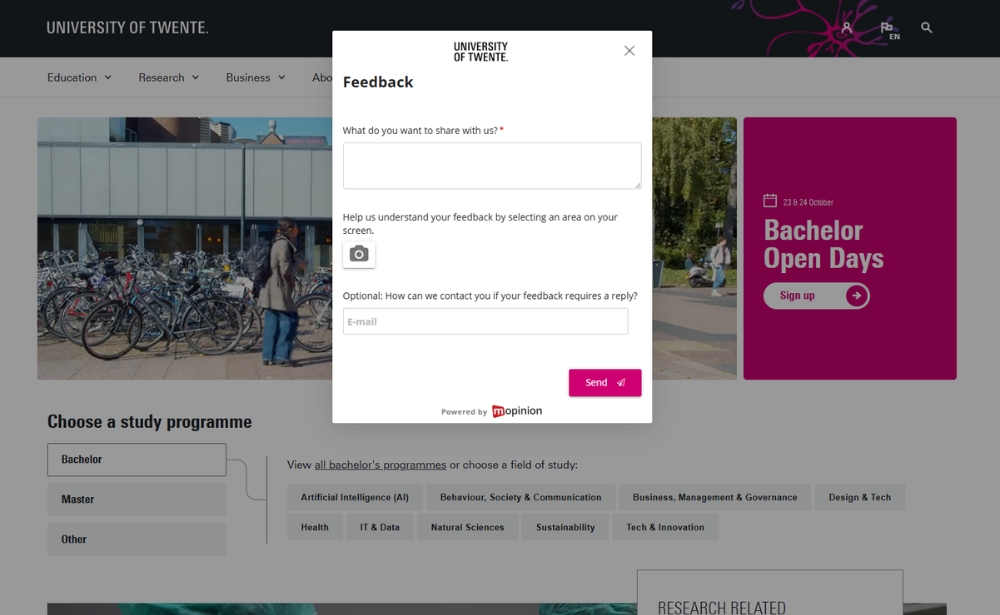
Although the University of Twente mainly uses Mopinion to report issues, the team also uses targeted feedback surveys when they need input on specific changes or pages.
“What we also do is put specific slide-in surveys on pages that we have questions about, or that have just been changed,” Anne says. “We try to collect a bit more user feedback to understand if our changes are appreciated or not.”
The team has also used exit surveys to understand why visitors leave specific parts of the website.
“We just collect feedback and directly fix what comes in,” Anne explains. “On top of that, we have some slide-in surveys on selected pages that we look at every two weeks. We have also done exit surveys to understand why people leave those pages.”
This gives the university a practical way to collect feedback in different situations: reporting issues, asking targeted questions and understanding user behaviour across key website journeys.
Adding context to website feedback
The University of Twente also uses Mopinion to add context when initial feedback does not explain enough on its own.
A simple rating or yes/no answer can show that something needs attention, but it does not always explain what the underlying issue is. In those cases, a short follow-up survey can help the team collect more detailed input.
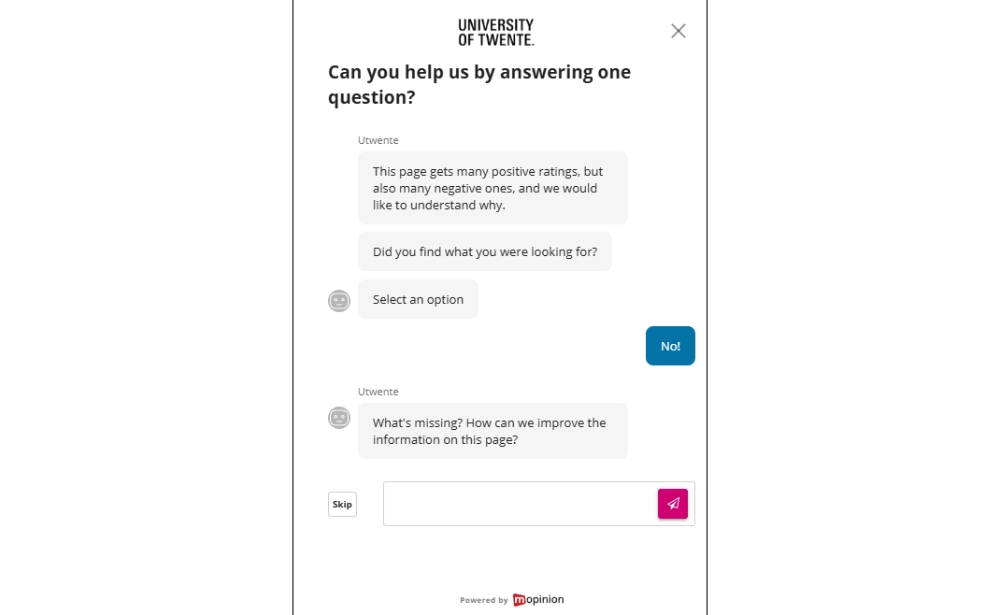
“We have a ‘Did you like this page? Yes/No’ question in our CMS for some internal pages,” Anne explains. “Several pages got a ‘No’ answer, and we had no clue why. That type of page is great for an extended survey of two or three questions, to help understand what is wrong.”
By adding context to initial feedback, the team can better understand user needs and prioritise improvements on specific pages.
Finding issues where you do not expect them
For Anne, one of the most valuable parts of collecting digital feedback is that visitors help the team uncover issues in places they may not have expected.
With a website of this size, issues can appear anywhere. Visitor feedback helps bring those issues to the surface.
“It is just great to see that your visitors help you find that weak spot,” Anne says.
This is especially useful for a large organisation like the University of Twente, where the website is constantly changing, and many different people contribute to its content.
Technical details that make feedback easier to act on
Another useful part of Mopinion is the technical information that comes with feedback.
In the past, the team would sometimes receive messages saying that the website did not work. However, without more context, it could be difficult to understand what was causing the issue.
With Mopinion, the team can see technical details such as browser, browser version, screen size and device type.
“What also really gives more insights is the technical specs you get,” Anne explains. “In the past, we got emails saying: the website does not work. Now we can say that your browser has not been updated in years and is unsafe. Please update it, and everything will work.”
This makes feedback easier to act on. It helps the team understand whether an issue is related to the website itself or to the visitor’s browser, device or setup.
For a large website team, that extra context can make a significant difference.
Easy to use and works really well
For the University of Twente, Mopinion has been easy to use from the start.
Anne explains that the software works as expected and is simple to work with.
“For the rest, it is just all that you expect: easy to use and working well.”
Recently, Anne has also started experimenting with Mopinion’s chat-style feedback feature, which guides users through a short series of questions. For her, it stands out as a new and interesting way to collect feedback.
“The chat also seems to work great,” Anne says. “This feature within feedback is pretty nice and new to me.”
Practical impact for the University of Twente
For the University of Twente, Mopinion’s impact is not measured through a broad online satisfaction score. Instead, the value is closely connected to the day-to-day reality of managing a large university website.
“We do not measure online user satisfaction,” Anne says. “We just use it to fix a lot of stuff or ask very specific opinions on something.”
This practical approach fits the university’s website environment. With tens of thousands of pages and many editors involved, Mopinion helps the team collect feedback continuously and turn it into concrete improvements.
It also helps the team work more efficiently. Feedback can be sent to the right people, technical issues can be understood with more context, and visitors can help identify weak spots that might otherwise go unnoticed.
Looking ahead: more feedback on new and improved sections
Looking ahead, the team sees even more value in using Mopinion on improved and newly launched sections of the website.
This is especially useful because users are often more willing to give feedback when something has recently changed.
“We plan to use it more on improved and new sections of the website,” Anne explains. “We have been doing that, but definitely need to use it more in those situations, because that is the moment people are willing to give more feedback.”
By using feedback at these moments, the University of Twente can better understand how users respond to changes and where further improvements may be needed.
A user-friendly European solution for large organisations
For the University of Twente, working with reliable digital software feedback is important, especially within the context of higher education. Mopinion gives the team a user-friendly way to collect feedback across a large website environment and act on what visitors report.
Looking ahead, Anne believes that large organisations that do not actively ask for feedback on their website are missing valuable opportunities.
“We just feel like we need a solution like this,” she says. “I believe that every large organisation that is not asking for active feedback on the website misses a lot of opportunities.”
When asked whether she would recommend Mopinion to other companies, organisations or universities looking for digital feedback software, Anne’s answer was clear:
“Definitely. For me, Mopinion feels like the best solution for large organisations looking for an EU-based, user-friendly solution.”
Thank you to Anne Heining and the University of Twente team for helping us tell their story.
Ready to see Mopinion in action?
Want to learn more about Mopinion’s all-in-1 user feedback platform? Don’t be shy and take our software for a spin! Do you prefer it a bit more personal? Just book a demo. One of our feedback pro’s will guide you through the software and answer any questions you may have.