
Customer feedback summarisation helps teams turn large volumes of open customer comments into clear, actionable insights. While scores and metrics can show what is happening, written feedback often explains why it is happening. The challenge is that qualitative feedback can be difficult and time-consuming to analyse at scale. By summarising feedback into topics, trends and sentiment, businesses can spot recurring issues faster, prioritise improvements and make better decisions based on what customers are actually saying.
TL;DR – Article Summary
Customer feedback summarisation helps businesses turn open comments, reviews and survey responses into clear insights. By using AI to group feedback into topics, identify sentiment and highlight recurring issues, teams can understand the “why” behind customer behaviour faster. Tools like Mopinion’s Smart Recaps help summarise digital feedback directly in the Mopinion platform, while Netigate Insights supports broader analysis across feedback sources, dashboards and segments.
In this article, we’ll dive into everything you need to know about how customer feedback summarisation can benefit your organisation. Not to mention, how using AI can speed up the process of analysing qualitative feedback and which tools can best assist you.
Here is a handy overview of the topics we’ll cover:
- What is customer feedback summarisation?
- How summarising customer feedback improves business decision-making
- What types of businesses benefit most from feedback summarisation?
- What role does AI play in customer feedback summarisation?
- 6 best customer feedback summarisation tools in 2026
Strap in! Here we go.
What is customer feedback summarisation?
Customer feedback summarisation is the process of analysing, categorising and summarising feedback you’ve received from customers. This could technically be any type of feedback. However, the term is most often used when talking about reviews or written comments in response to an open-ended question.
Below is an example of a typical open-ended ended feedback question:
‘In your own words, could you tell us more about what you liked/didn’t like about your experience with us?’
As you might know, written feedback is considered qualitative data, while responses to multiple choice questions fall under quantitative data.
Qualitative data is often trickier to analyse, since it doesn’t easily translate into charts or graphs in an analytics platform. That’s where customer feedback summarisation comes in, it’s a handy tool for gaining deeper insights from open-ended responses
How summarising customer feedback improves business decision-making
Summarising customer feedback makes your qualitative data digestible. Which in turn allows you to:
- Detect issues
- Easily set priorities
- Create tangible action plans
- Democratise insights through your entire organisation
All this drives improvements across your organisation and makes the customer feedback loop more effective.
Qualitative feedback, like written comments and reviews, is often where you find the key to making your data actionable. That’s why it’s important that it doesn’t go overlooked. While quantitative feedback can show you how your users are acting, qualitative data is how you unlock the ‘why’ behind their behaviour.
In the end, listening to your customers is the key to elevate your customer experience and refine your product(s) and service(s). Which in turn will boost conversion, customer loyalty and revenue.
What types of businesses benefit most from feedback summarisation?
Which businesses that benefit the most from feedback summarisation have less to do with what your business idea is and more to do with the amount of feedback you collect.
The larger the amount, the harder it is to get an overview. Typically, it’s businesses within the business-to-consumer (B2C) industry that collect data of this caliber. Think retail, telecom providers, travel and hospitality, etc.

However, if your website has many visitors, chances are, you are also collecting a steady amount of feedback. This means that public authorities also aren’t strangers to the benefits of customer feedback summarisation.
To summarise: If your business has many website visitors, or is collecting large amounts of feedback through email or app, you could definitely benefit from customer feedback summarisation.
What role does AI play in customer feedback summarisation?
You probably don’t need us to tell you that AI has exploded across the market in recent years and customer experience analytics is no exception.
Automating customer feedback comes with some clear benefits:
- Time saved: Spending hours going through hundreds, or even thousands, of feedback messages or reviews is time-consuming to say the least.
Having AI do the heavy lifting for you ensures that you spend less time analysing and more time implementing meaningful improvements, found in your qualitative feedback.
- Less error-prone: It is easy to accidentally mislabel data or look for evidence to confirm an existing thesis when categorising customer feedback manually. Automation helps you overcome these issues.
- Faster decision making: As you spend less time analysing, you can also close the feedback loop quicker.
- Prioritising urgent issues: Automated summaries will help you get to urgent issues while there is still time to fix them.
As with all AI solutions, however, the quality of the solutions currently on the market varies. In other words, there are a few things to keep in mind when choosing what is best for you.

Often, AI solutions are obtained via acquisition, i.e. customer experience companies buying other customer experience companies. As a result, these tools aren’t always the best fit for the brand and they don’t always align perfectly with customer needs either.
Another consequence of these kinds of solutions is that they are often separate from the rest of the product the company is selling. Meaning you need multiple logins and systems to analyse your data.
Last, but not least: security. With the rise of AI and increasing volumes of personal data, secure and privacy-compliant handling is more critical than ever, especially since the introduction of GDPR in Europe.
Many AI-powered feedback tools, however, are simply integrated with external platforms like ChatGPT. In these cases, the companies selling the software may not actually store the data in their own secure cloud environments — raising important questions about data ownership and compliance.
In short: when you are choosing a provider, ensure that you choose a solution that is both a good fit for your company and that prioritises privacy. Which leads us too…
The 6 best customer feedback summarisation tools in 2026
1. Mopinion – Smart Recaps

Mopinion’s (hi, that’s us!👋) solution for customer feedback summaries, Smart Recaps, uses generative AI to create concise summaries of your open feedback responses, sorted into topics.
With the help of sentiment analysis, Smart Recaps also shows you how much of your feedback is positive, negative and neutral. This helps you see which topics need urgent attention, as well as what you are already doing well.
Need more detailed insights? No problem, you can easily dive deeper and check out each individual comment. You’ll find them categorised into both topic and sentiment.
Additionally, Mopinion is fully specialised in customer feedback. More general CX toolsuites might offer several generic solutions. However, as a result, these are often not tailor-made to your specific needs. Not to mention the fact that the different features run in separate modules and systems, making analysis processes a lot more difficult and time-consuming than they need to be.
Since Mopinion is built specifically to excel in customer feedback, you can skip the extra hassle and get straight to the insights. You’ll find Smart Recaps in the regular Mopinion platform. No separate systems, log-ins or extra steps (such as exporting and uploading data) is needed to see your feedback summaries. Lastly, the AI technology Smart Recaps is built on runs entirely within Mopinion’s cloud environment, without relying on external AI systems like ChatGPT.
In a nutshell, Smart Recaps:
- Helps you spot urgent issues
- Eliminates human error in categorisation and analysis
- Saves you the time and hassle of manually reading and categorising customer feedback responses
- Allows you to close the feedback loop quicker
- Adheres to privacy laws, such as GDPR
Read more about Smart Recaps.
2. Netigate Insights
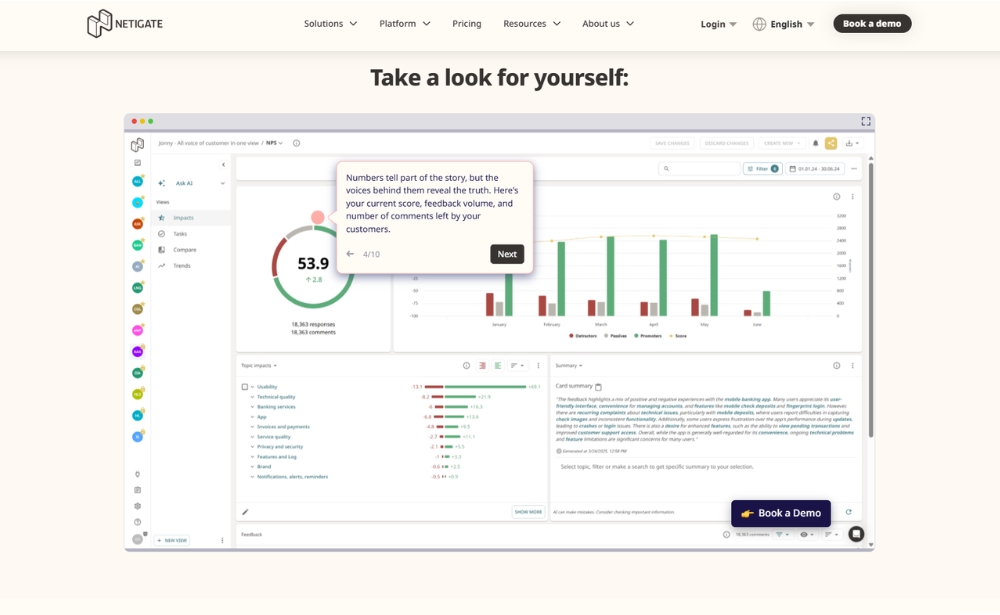
Netigate Insights helps organisations analyse feedback data across different sources and turn it into clear, shareable insights. It is especially useful for teams that want to go beyond individual feedback summaries and explore broader patterns, segments and trends.
With dashboards, filtering and visual reporting, Netigate Insights can help teams compare results, identify recurring themes and understand how feedback differs across customer groups, channels or touchpoints.
For Mopinion users, Netigate Insights can complement Smart Recaps. Smart Recaps helps summarise open digital feedback directly in Mopinion, while Netigate Insights supports broader analysis across multiple feedback sources and reporting needs.
Netigate Insights is a strong fit for organisations that:
- collect feedback from multiple channels
- want to analyse trends across different customer groups
- need dashboards and visual reporting
- want to share insights across teams
- need a broader view of customer experience data
3. Medallia – Medallia AI

Medallia’s solution for customer feedback summaries creates clear overviews of your client responses and reviews, complete with sentiment analysis. In addition, Medallia has a text and speech analytics feature that can expand on more complex emotions like ‘excitement’, ‘confusion’ or ‘frustration’.
One thing to note, however, is that Medallia is a customer experience (CX) management platform, with a strong emphasis on collecting both online and offline data. Naturally, they offer a number of tools to support this, rather than specialising on specifically customer feedback.
Because of this, their features and data are often found in separate modules and systems, which can lead to extra steps.
4. Qualtrics – Comment Summaries Widget (EX)

Source: Qualtrics
This customer feedback summarisation tool from Qualtrics comes in the form of a widget. It creates handy overviews, complete with sentiment analysis, allowing you to identify urgent topics or improvement areas.
However, something to keep in mind with this widget, is that it still requires some manual labour from you to analyse your data. For example, you first need to export your feedback and upload it to Qualtrics’ text analysis tool, Text iQ, before you can access your summaries.
5. Survicate – AI Surveys

Source: Survicate
Survicate’s solution for customer feedback summaries allows you to collect feedback from different channels (like reviews, customer service messages and feedback forms) and analyse them on one platform.
As with the other solutions in this list, AI Surveys automatically sorts feedback into topics and gives a coherent overview. However, the overview does not include sentiment analysis, which can make it more difficult when prioritising which actions to take.
6. SurveyMonkey – SurveyMonkey Genius

Source: Survey Monkey
Survey Monkey Genius is a tool that helps you both create surveys and analyse your responses. It’s helpful when creating surveys on a smaller scale and when conducting marketing research or other campaigns aligned with sending out traditional surveys.
Survey Monkey’s natural language processing categorises your responses as positive, negative or neutral, giving you a clear indication of your customers’ general feelings. Additionally, it can give you insights into if you are scoring bad within a certain target group and remove poor-quality responses.
Choosing a customer feedback summary solution that works for you
Customer feedback summarisation can help your team move from raw comments to clearer priorities. This is especially valuable if your organisation collects large volumes of open feedback across websites, mobile apps, email campaigns, surveys, reviews or support channels.
The right solution depends on what kind of feedback you collect and how your teams want to use the insights. Mopinion’s Smart Recaps helps digital teams summarise open feedback directly in the Mopinion platform, while Netigate Insights supports broader analysis across multiple feedback sources, dashboards and segments.
The most important thing is to choose a solution that helps you connect qualitative feedback to action. Scores and metrics can show what is happening, but open comments often explain why it is happening. When those comments are summarised clearly and shared across teams, customer feedback becomes much easier to act on.
Ready to see Mopinion in action?
Want to learn more about Mopinion’s all-in-1 user feedback platform? Don’t be shy and take our software for a spin! Do you prefer it a bit more personal? Just book a demo. One of our feedback pro’s will guide you through the software and answer any questions you may have.